Custom Enzyme Formulation for Custom Formulation: Buyer Specification Checklist
Compare custom enzyme formulation for custom formulation, private label, and OEM enzyme supply with specs, QC, pilot validation, and cost-in-use.

Selecting an industrial enzyme partner is easier when performance targets, process limits, documentation, and scale-up responsibilities are defined before pricing discussions begin.
How to Compare Custom Enzyme Formulation Options
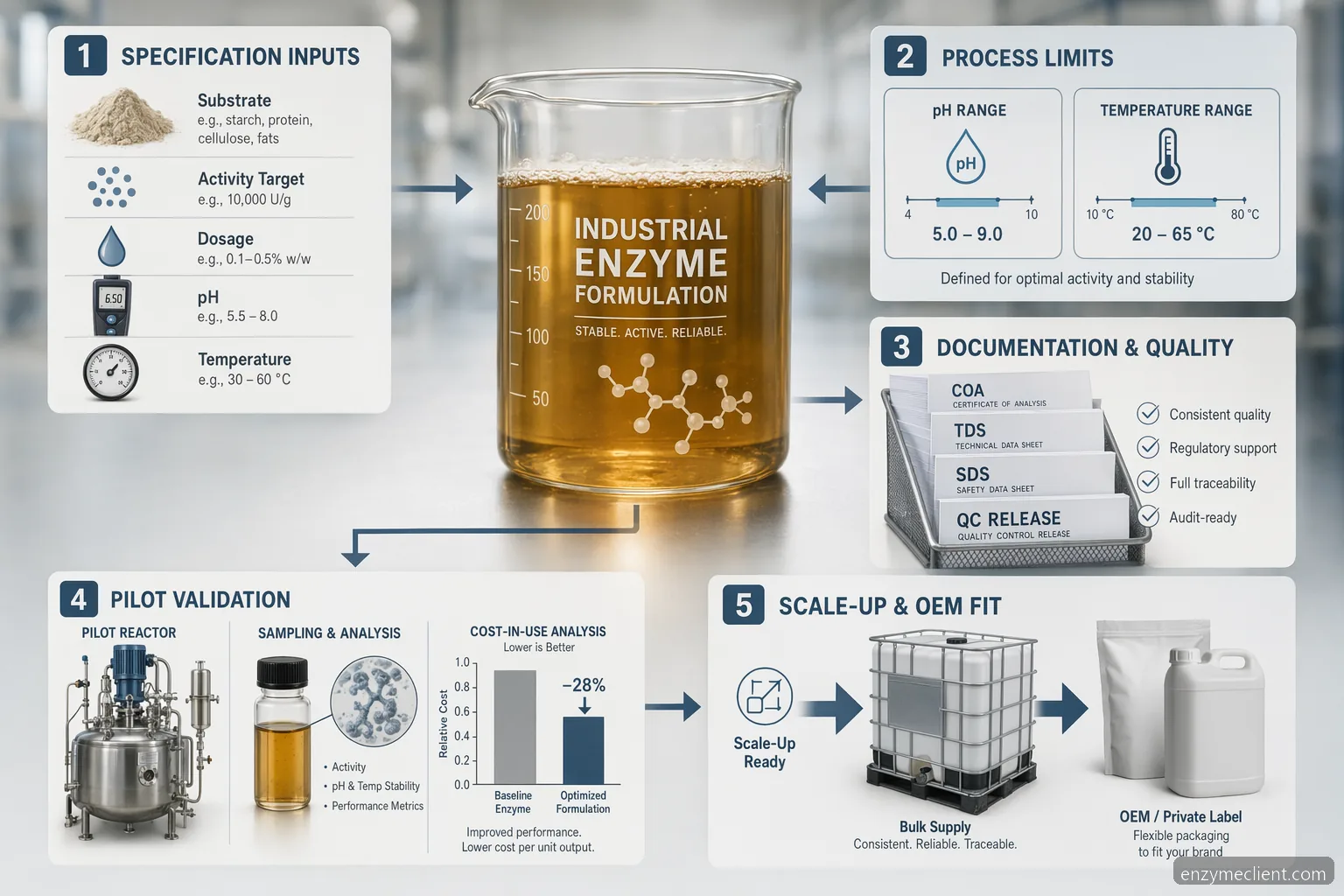
A strong comparison starts with the real operating window, not a generic enzyme category. For custom formulation projects, document the substrate, solids level, water activity, pH, temperature, mixing intensity, residence time, and downstream processing. Many industrial enzymes perform best within pH 4.0-8.5 and 25-65°C, but the right range depends on enzyme class, carrier system, stabilizers, and exposure time. Ask each supplier to explain how the proposed formulation maintains activity under your process conditions and storage conditions. This is especially important when comparing enzyme contract manufacturing for custom formulation against a standard catalog blend. A credible proposal should translate enzyme activity into a practical dosage band, expected performance metric, and test method. For B2B buyers, the best choice is usually the supplier that can connect formulation design, pilot validation, QC release, and production economics in one documented workflow.
Define target performance before asking for pricing. • Compare stability under your actual pH and temperature window. • Request dosage guidance by mass, volume, or activity unit. • Evaluate cost-in-use, not only price per kilogram.
Specification Inputs for Industrial Custom Formulation
Industrial custom enzyme formulation custom formulation projects need a practical specification checklist. Start with enzyme function: hydrolysis, viscosity reduction, starch conversion, protein modification, fiber treatment, cleaning support, waste treatment, or process yield improvement. Then define the matrix: aqueous liquid, powder blend, slurry, concentrate, granule, tablet, or water-soluble pack. For safe initial screening, dosage bands often begin around 0.01-1.0% by weight, or an equivalent activity-based rate, then narrow after lab trials. Temperature exposure may include ambient storage, 40°C accelerated stability, or process contact at 50-60°C. pH screening should cover the normal operating range plus likely excursions. If you are seeking industrial enzyme contract manufacturing custom formulation, include preferred carriers, preservatives, dust control needs, viscosity limits, color constraints, odor limits, and packaging formats. These inputs reduce reformulation cycles and help suppliers quote realistic development timelines.
List forbidden or preferred excipients and carriers. • Provide target viscosity, solubility, and dispersion requirements. • Include storage temperature and expected shelf life. • Specify liquid, powder, granule, or concentrate format.
Documentation: COA, TDS, SDS, and QC Release
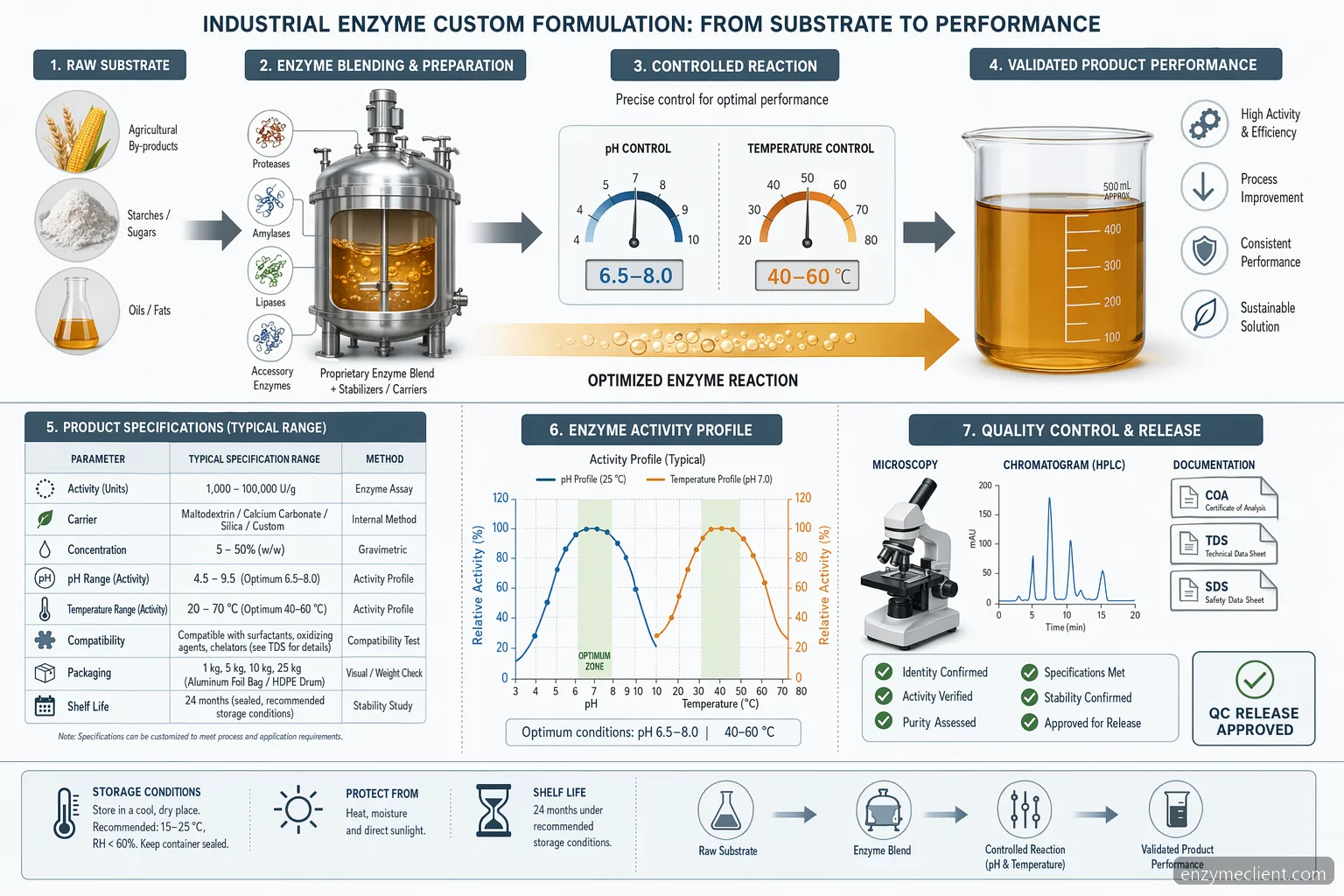
Documentation quality is a major differentiator between commodity supply and a qualified enzyme contract manufacturing supplier for custom formulation. At minimum, request a Technical Data Sheet for recommended use conditions, a Safety Data Sheet for handling and transport information, and a Certificate of Analysis for each production lot. The COA should state the relevant activity assay, specification limits, appearance, microbiological checks where applicable, moisture or solids, pH, and any project-specific release criteria. The TDS should avoid vague claims and provide usable guidance such as recommended pH range, temperature range, dosage starting point, storage conditions, and compatibility notes. For private label or enzyme OEM projects, confirm label responsibilities, retained samples, change notification expectations, and lot traceability. Supplier qualification should also review batch records, QC methods, deviation handling, sample retention, and whether scale-up equipment matches the product format.
Request current COA, TDS, and SDS before approval. • Confirm activity assay method and acceptance limits. • Review lot traceability and change control practices. • Align label, packaging, and document ownership early.
Pilot Validation and Cost-in-Use Comparison
Pilot validation turns a proposed custom enzyme formulation supplier for custom formulation into measurable operating data. A useful pilot compares at least three dosage points, such as 0.05%, 0.10%, and 0.25% by weight, or equivalent activity units, across realistic pH, temperature, and contact time conditions. Track the business outcome: conversion rate, yield gain, viscosity drop, brightness change, cleaning time reduction, solids release, wastewater load reduction, or another agreed metric. Include a control run without enzyme and, where possible, a benchmark formulation. Cost-in-use should include dosage, dilution, labor, heating or cooling needs, process time, waste reduction, rejected batch risk, freight, packaging, and inventory stability. The lowest unit price is not always the lowest production cost. A pilot protocol also helps compare custom enzyme formulation for private label against custom enzyme formulation for custom formulation when both require different packaging, claims, and QC release criteria.
Run a no-enzyme control and a benchmark comparison. • Measure one primary outcome and two secondary outcomes. • Calculate cost per processed ton, batch, or finished unit. • Confirm performance after realistic storage exposure.
Private Label, OEM, and Contract Manufacturing Fit
Industrial custom enzyme formulation private label projects require more than filling a container with an active blend. The supplier must support formulation ownership, packaging compatibility, production repeatability, and document control. If you need a custom enzyme formulation supplier for private label, compare minimum order quantities, lead times, label review support, confidentiality practices, retained samples, and change notification procedures. Enzyme OEM projects may also require concentrate supply, toll blending, repacking, or a finished product ready for distribution. Ask whether the manufacturer can handle liquids, dry blends, granules, low-dust formats, or water-dispersible concentrates. Review packaging options such as drums, totes, pails, bags, or sachets based on moisture sensitivity and operator handling. The right enzyme contract manufacturing supplier should help convert your application target into a stable, manufacturable, QC-released product without making unsupported performance claims.
Compare MOQ, lead time, and packaging flexibility. • Confirm confidentiality and formulation ownership terms. • Check liquid and powder manufacturing capabilities. • Require written change notification for critical inputs.
Technical Buying Checklist
Buyer Questions
Provide the substrate, target performance metric, pH range, temperature range, contact time, batch size, form factor, packaging preference, and any restricted ingredients. Include current process data and a benchmark if available. This allows the supplier to recommend a realistic dosage band, development plan, QC release criteria, pilot protocol, and cost-in-use estimate instead of quoting an unsuitable generic enzyme blend.
Evaluate contract manufacturers on formulation capability, pilot support, QC methods, document quality, batch traceability, packaging options, and production repeatability. Ask for sample COA, TDS, and SDS documents, then review whether activity assays and release limits match your application. A good supplier qualification process also checks change notification practices, retained samples, lead times, minimum order quantities, and ability to scale from pilot to commercial batches.
Private label enzymes are typically finished products packaged for your brand, while enzyme OEM supply may involve concentrates, intermediates, toll blends, or finished formulations integrated into your product line. Both require clear ownership of specifications, labeling responsibilities, document control, and change notification. For industrial custom enzyme formulation private label work, packaging compatibility, shelf-life data, and repeatable QC release are especially important.
Common QC checks include enzyme activity assay, appearance, odor, pH, viscosity for liquids, moisture for powders, solids content, density, and microbiological limits where relevant to the application. Additional checks may include particle size, dust behavior, solubility, preservative level, or stability after accelerated storage. The COA should list the agreed tests, methods or method references, specification ranges, and lot-specific results.
Price per kilogram ignores activity concentration, dosage rate, stability, process time, yield impact, waste reduction, and rejected batch risk. A higher-priced formulation may cost less per finished unit if it works at a lower dosage or shortens production time. During pilot validation, compare cost per ton, batch, or finished unit using real operating conditions, not just supplier list prices.
Related Search Themes
industrial enzyme contract manufacturing custom formulation, industrial custom enzyme formulation private label, industrial custom enzyme formulation custom formulation, enzyme contract manufacturing supplier for custom formulation, enzyme contract manufacturing for custom formulation, custom enzyme formulation supplier for private label
Lipase (Thermostable) for Research & Industry
Need Lipase (Thermostable) for your lab or production process?
ISO 9001 certified · Food-grade & research-grade · Ships to 80+ countries
Frequently Asked Questions
What should I provide before requesting a custom enzyme formulation quote?
Provide the substrate, target performance metric, pH range, temperature range, contact time, batch size, form factor, packaging preference, and any restricted ingredients. Include current process data and a benchmark if available. This allows the supplier to recommend a realistic dosage band, development plan, QC release criteria, pilot protocol, and cost-in-use estimate instead of quoting an unsuitable generic enzyme blend.
How is enzyme contract manufacturing for custom formulation evaluated?
Evaluate contract manufacturers on formulation capability, pilot support, QC methods, document quality, batch traceability, packaging options, and production repeatability. Ask for sample COA, TDS, and SDS documents, then review whether activity assays and release limits match your application. A good supplier qualification process also checks change notification practices, retained samples, lead times, minimum order quantities, and ability to scale from pilot to commercial batches.
What is the difference between private label enzymes and enzyme OEM supply?
Private label enzymes are typically finished products packaged for your brand, while enzyme OEM supply may involve concentrates, intermediates, toll blends, or finished formulations integrated into your product line. Both require clear ownership of specifications, labeling responsibilities, document control, and change notification. For industrial custom enzyme formulation private label work, packaging compatibility, shelf-life data, and repeatable QC release are especially important.
Which QC checks are common for industrial enzyme formulations?
Common QC checks include enzyme activity assay, appearance, odor, pH, viscosity for liquids, moisture for powders, solids content, density, and microbiological limits where relevant to the application. Additional checks may include particle size, dust behavior, solubility, preservative level, or stability after accelerated storage. The COA should list the agreed tests, methods or method references, specification ranges, and lot-specific results.
Why is cost-in-use better than comparing price per kilogram?
Price per kilogram ignores activity concentration, dosage rate, stability, process time, yield impact, waste reduction, and rejected batch risk. A higher-priced formulation may cost less per finished unit if it works at a lower dosage or shortens production time. During pilot validation, compare cost per ton, batch, or finished unit using real operating conditions, not just supplier list prices.
Related: Custom Enzyme Formulation for Demanding Process Lines
Turn This Guide Into a Supplier Brief Share your process conditions and target outcome to request a custom enzyme formulation review. See our application page for Custom Enzyme Formulation for Demanding Process Lines at /applications/custom-enzyme-formulation-faqs/ for specs, MOQ, and a free 50 g sample.
Contact Us to Contribute