Customized Enzyme Formulation for Industrial Buyers
B2B guide to customized enzyme formulation, contract manufacturing, private label enzymes, QC, pilot validation, and cost-in-use.
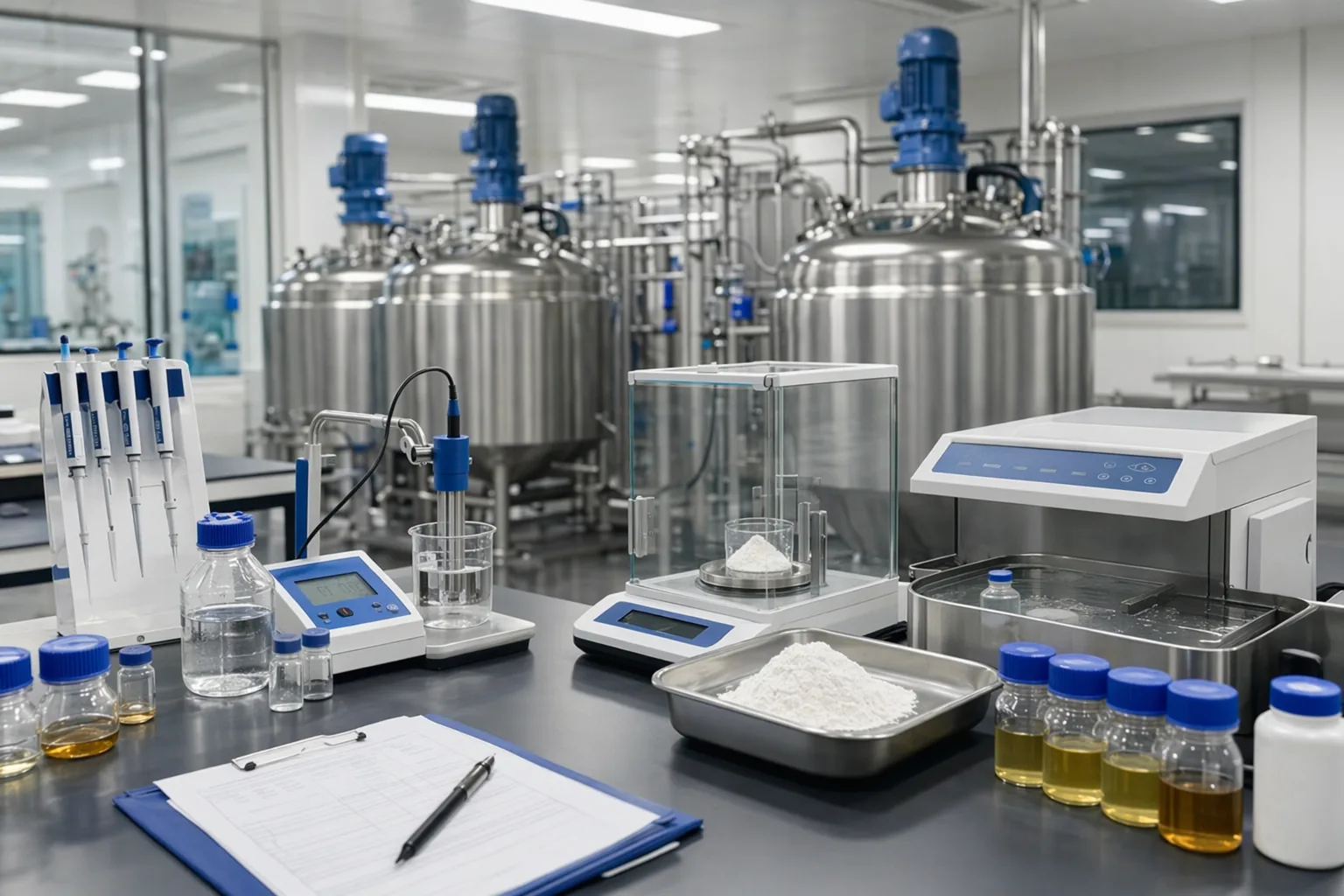
Build application-ready enzyme products with defined activity, stability, handling, and documentation for custom formulation and private label programs.
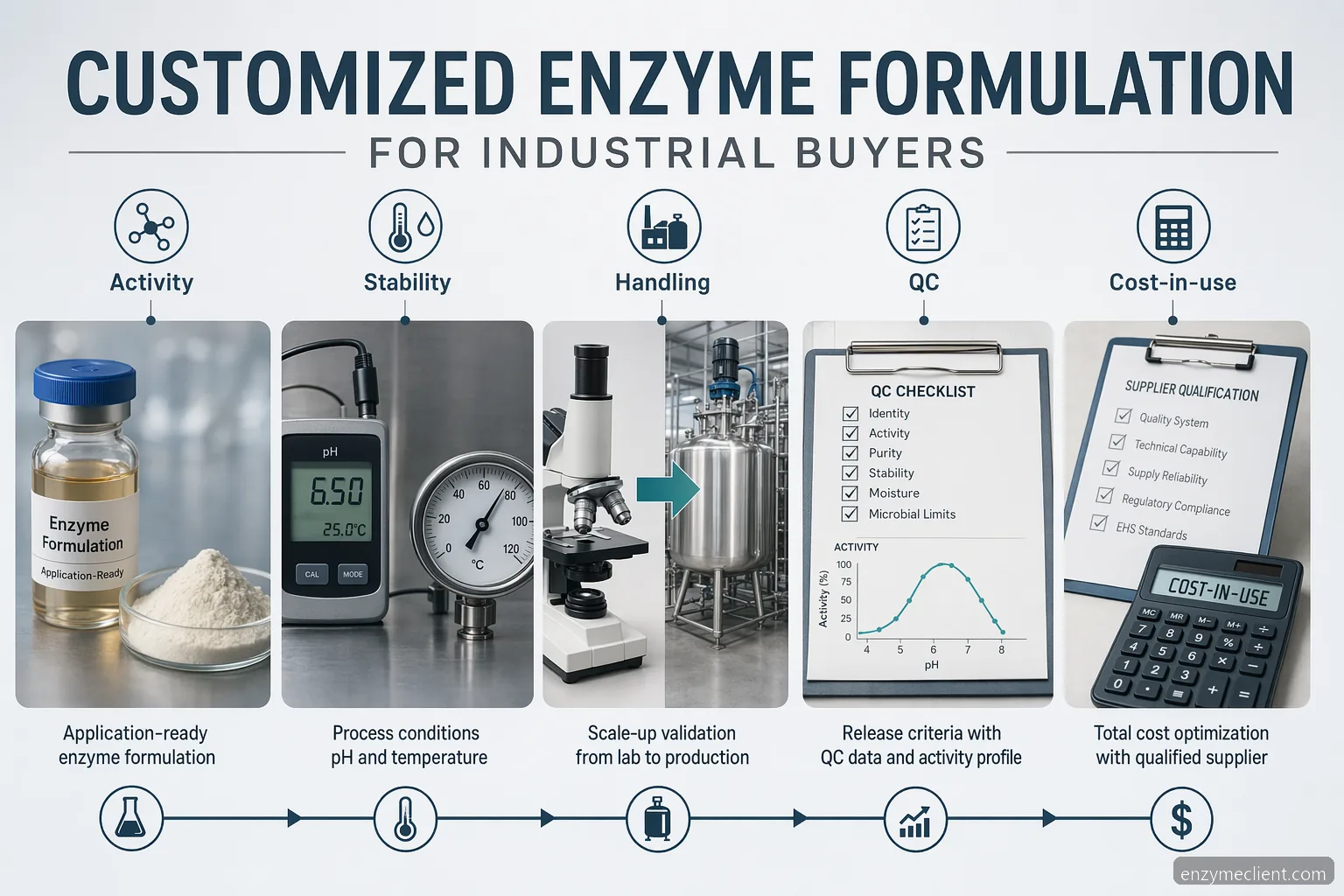
What Customized Enzyme Formulation Means in Industrial Supply
Customized enzyme formulation is the development of an enzyme product tailored to a buyer’s production process, substrate, handling system, and commercial format. Instead of purchasing a generic liquid or powder, the buyer defines the application target, such as improved conversion, viscosity reduction, cleaning performance, fiber modification, or processing yield. The supplier then adjusts enzyme type, activity level, stabilizer system, carrier, preservative, pH profile, and packaging. For B2B buyers, this is especially relevant when standard products create inconsistent results, excessive dosage, poor storage stability, or handling problems. An industrial custom enzyme formulation private label project may also include label-ready documentation, pack size selection, and batch release criteria. The goal is not simply higher activity; it is predictable performance under real plant conditions, supported by technical data, pilot validation, and clear cost-in-use modeling.
Useful for liquid, powder, granule, and blended enzyme formats • Common in food processing, textile, feed, pulp, detergent, and wastewater applications • Designed around process performance, not only enzyme activity
Process Conditions to Define Before Formulation
A reliable custom enzyme formulation for custom formulation begins with process mapping. Buyers should provide the substrate type, solids level, pH, temperature, process time, mixing intensity, water hardness, inhibitors, and downstream constraints. Many industrial enzymes operate effectively in pH 4.0–9.0 and 30–70°C ranges, but the correct window depends on enzyme class and application. For example, acidic systems may need stability around pH 4.5–5.5, while alkaline cleaning or textile processes may require pH 8.0–10.5 tolerance. Typical initial dosage screening may start around 0.01–0.5% w/w of process mass or 50–1,000 ppm active preparation, then narrow through trials. Salt, surfactants, oxidizers, metal ions, and preservatives can affect activity retention, so they should be disclosed early. These details help the enzyme contract manufacturing supplier for custom formulation choose an appropriate enzyme source and stabilization approach.
Define pH and temperature at dosing, reaction, and hold stages • Share residence time, dilution point, and shear conditions • Identify incompatible chemicals before pilot production
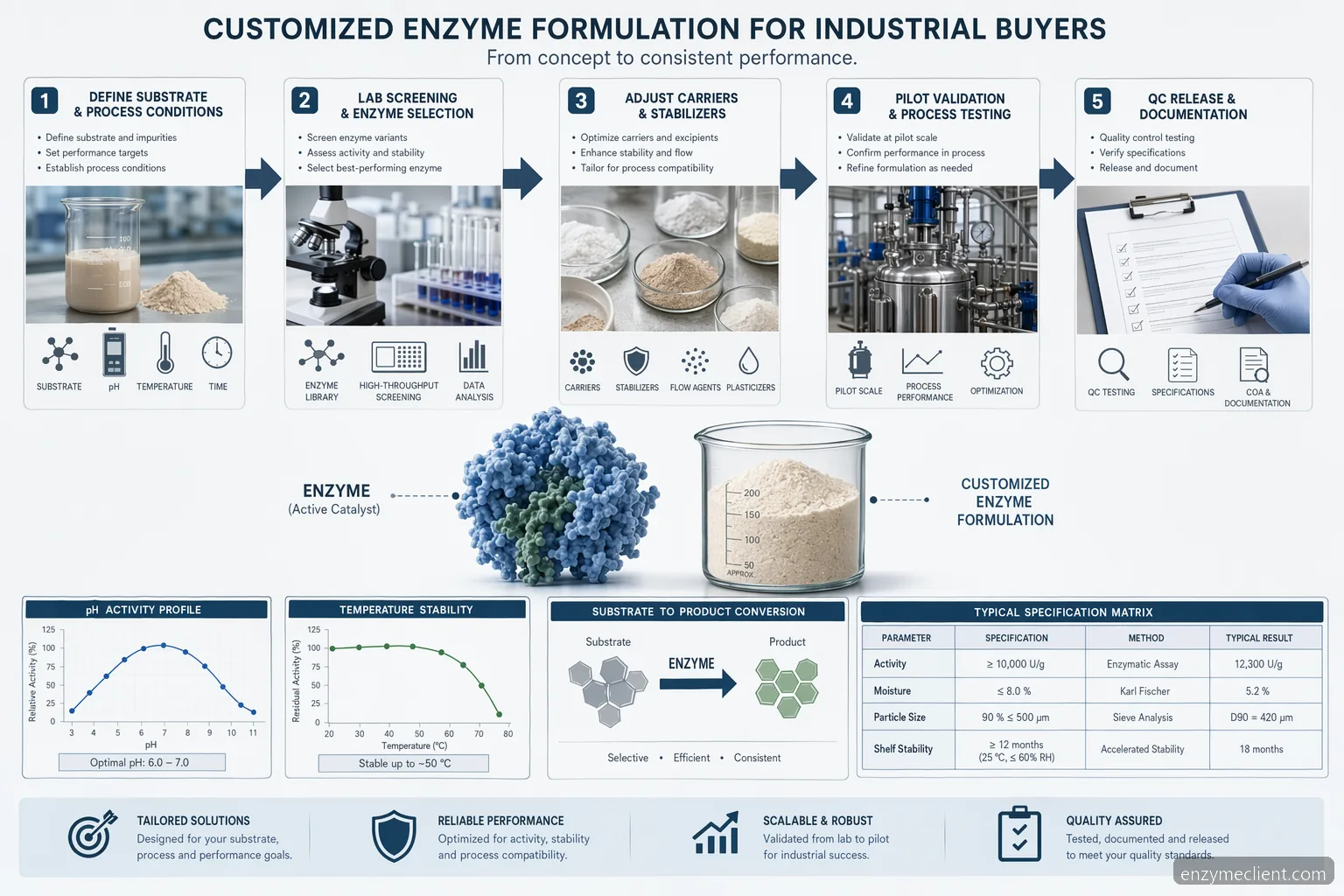
From Lab Screening to Pilot Validation
Industrial enzyme contract manufacturing custom formulation should include a staged validation plan. Lab screening compares candidate enzymes under controlled pH, temperature, dosage, and time conditions using the buyer’s real substrate where possible. A short list is then tested for activity retention, compatibility, and functional performance. Pilot validation confirms whether the formulation performs in plant-like equipment, realistic batch sizes, and normal variation in raw materials. Practical checks may include viscosity reduction, reducing sugar release, stain removal index, filtrate clarity, fiber strength, COD reduction, or yield improvement, depending on the application. Pilot trials should also monitor foam, odor, pumpability, solubility, dusting, sedimentation, and cleaning requirements. A strong supplier will document trial conditions and help convert results into operating dosage bands, such as a recommended start dose, minimum effective dose, and upper economic limit.
Use the buyer’s substrate or a validated representative material • Compare performance against the incumbent or blank control • Record dosage, contact time, temperature, and pH for every trial
Quality Control, Documentation, and Release Criteria
A custom enzyme formulation supplier for private label or custom formulation should provide documentation suitable for technical purchasing, quality, and production teams. Core documents normally include a Certificate of Analysis, Technical Data Sheet, and Safety Data Sheet. The COA should identify batch number, activity specification, appearance, pH or moisture where relevant, and release date. The TDS should describe recommended use conditions, dosage guidance, storage, shelf life, and handling precautions. QC checks may include enzyme activity by validated assay, microbial limits where applicable, bulk density for powders, viscosity for liquids, pH, moisture, particle size, and visual inspection. Buyers should confirm whether specifications are release limits or typical values. For private label enzymes, artwork and claims should align with documented performance data and should avoid unsupported statements. Batch retain samples and traceability records also support complaint investigation and continuous improvement.
Request COA, TDS, SDS, and batch traceability before approval • Define activity units and test method clearly • Agree on retain sample period and deviation handling
Cost-in-Use and Supplier Qualification
For enzyme contract manufacturing for custom formulation, the lowest price per kilogram is not always the best commercial choice. Buyers should calculate cost-in-use by comparing dosage, activity retention during storage, conversion efficiency, process time reduction, waste reduction, and impact on downstream operations. A more concentrated or better-stabilized formulation may reduce freight, storage, dosing labor, or rework. Supplier qualification should review technical capability, formulation experience, production scale, change-control process, confidentiality practices, lead time, packaging options, and responsiveness during trials. Ask whether the supplier can support scale-up from lab samples to pilot batches and recurring commercial lots without changing critical raw materials unexpectedly. For industrial custom enzyme formulation custom formulation projects, a practical qualification package includes sample evaluation, pilot report, agreed specification, documentation review, commercial quotation, and supply continuity plan.
Compare total cost per treated ton, batch, or production run • Confirm minimum order quantity, lead time, and packaging formats • Use formal change notification for enzyme source or formulation changes
Technical Buying Checklist
Buyer Questions
Provide the application, substrate, current process conditions, target outcome, pH, temperature, residence time, batch size, and any chemicals present. Include your preferred liquid or powder format, dosage target, packaging, annual volume estimate, and documentation needs such as COA, TDS, and SDS. If possible, share benchmark performance data or a sample of the substrate for screening.
Timing depends on complexity, sample availability, and validation depth. A straightforward reformulation may move from technical review to lab sample in a few weeks, while a new industrial custom enzyme formulation private label program may require lab screening, pilot testing, specification approval, packaging confirmation, and commercial batch scheduling. Buyers should allow additional time for stability checks and internal qualification.
Yes, some suppliers can support enzyme contract manufacturing, custom formulation, and private label packaging under one project plan. Buyers should verify blending capability, filling formats, labeling process, lot traceability, QC release testing, and documentation control. It is also important to confirm minimum order quantities, lead times, change-control practices, and whether the supplier can scale from pilot batches to repeat commercial production.
Compare suppliers using technical fit, pilot performance, documentation quality, batch consistency, responsiveness, and cost-in-use rather than price alone. Review COA format, activity assay method, SDS completeness, TDS clarity, stability data, packaging options, and change notification process. A strong custom enzyme formulation supplier for custom formulation should help define trial conditions and provide practical recommendations for plant adoption.
Typical QC tests include enzyme activity, appearance, pH, moisture for powders, viscosity for liquids, bulk density, solubility or dispersibility, particle size, and microbial checks where relevant to the application. The exact release criteria should match the product format and industry use. Buyers should agree on test methods, specification limits, COA items, retain samples, and how deviations are reviewed.
Related Search Themes
industrial enzyme contract manufacturing custom formulation, industrial custom enzyme formulation private label, industrial custom enzyme formulation custom formulation, enzyme contract manufacturing supplier for custom formulation, enzyme contract manufacturing for custom formulation, custom enzyme formulation supplier for private label
Lipase (Thermostable) for Research & Industry
Need Lipase (Thermostable) for your lab or production process?
ISO 9001 certified · Food-grade & research-grade · Ships to 80+ countries
Frequently Asked Questions
What information should we provide for a customized enzyme formulation quote?
Provide the application, substrate, current process conditions, target outcome, pH, temperature, residence time, batch size, and any chemicals present. Include your preferred liquid or powder format, dosage target, packaging, annual volume estimate, and documentation needs such as COA, TDS, and SDS. If possible, share benchmark performance data or a sample of the substrate for screening.
How long does enzyme custom formulation usually take?
Timing depends on complexity, sample availability, and validation depth. A straightforward reformulation may move from technical review to lab sample in a few weeks, while a new industrial custom enzyme formulation private label program may require lab screening, pilot testing, specification approval, packaging confirmation, and commercial batch scheduling. Buyers should allow additional time for stability checks and internal qualification.
Can one supplier handle enzyme contract manufacturing and private label packaging?
Yes, some suppliers can support enzyme contract manufacturing, custom formulation, and private label packaging under one project plan. Buyers should verify blending capability, filling formats, labeling process, lot traceability, QC release testing, and documentation control. It is also important to confirm minimum order quantities, lead times, change-control practices, and whether the supplier can scale from pilot batches to repeat commercial production.
How should we compare two custom enzyme formulation suppliers?
Compare suppliers using technical fit, pilot performance, documentation quality, batch consistency, responsiveness, and cost-in-use rather than price alone. Review COA format, activity assay method, SDS completeness, TDS clarity, stability data, packaging options, and change notification process. A strong custom enzyme formulation supplier for custom formulation should help define trial conditions and provide practical recommendations for plant adoption.
What QC tests are typical for industrial enzyme formulations?
Typical QC tests include enzyme activity, appearance, pH, moisture for powders, viscosity for liquids, bulk density, solubility or dispersibility, particle size, and microbial checks where relevant to the application. The exact release criteria should match the product format and industry use. Buyers should agree on test methods, specification limits, COA items, retain samples, and how deviations are reviewed.
Related: Custom Enzyme Formulation for Demanding Process Lines
Turn This Guide Into a Supplier Brief Discuss your customized enzyme formulation project with enzymeclient.com and request a technical review, pilot plan, and private label quotation. See our application page for Custom Enzyme Formulation for Demanding Process Lines at /applications/custom-enzyme-formulation-faqs/ for specs, MOQ, and a free 50 g sample.
Contact Us to Contribute