Enzyme Contract Manufacturing for Custom Formulation
Source enzyme contract manufacturing for custom formulation, private label enzymes, pilot validation, QC, COA/TDS/SDS, and cost-in-use support.

Build an industrial enzyme program with tailored activity, stable delivery format, documented QC, and a manufacturing partner prepared for scale-up and private label supply.
What Buyers Need from a Custom Enzyme Manufacturing Partner
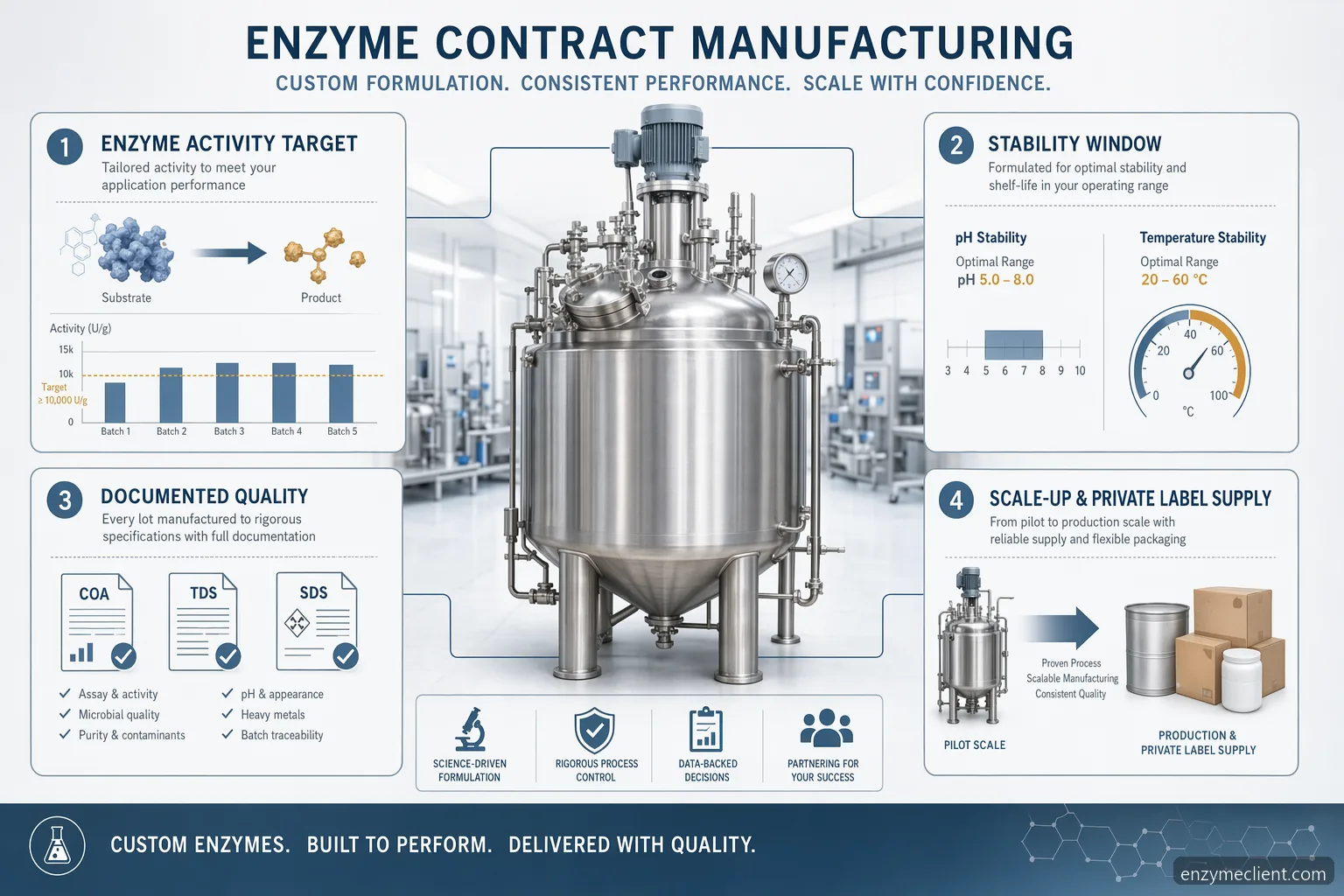
Industrial buyers sourcing enzyme contract manufacturing for custom formulation usually need more than a catalog enzyme. The goal is a fit-for-process product that matches the substrate, processing window, equipment, cleaning method, and commercial packaging plan. A qualified enzyme contract manufacturing supplier for custom formulation should translate application targets into measurable specifications: activity units, carrier system, preservative package, viscosity, solubility, particle profile, odor limits, and shelf-life expectations. For private label enzymes or enzyme OEM programs, the supplier should also manage label-ready formats, batch records, retain samples, and documentation that supports downstream customer approvals. Early scoping should define the application, feedstock variability, target conversion or cleaning result, allowable residues, regulatory destination, and estimated annual volume. This prevents expensive reformulation after pilot trials and helps align technical, procurement, and quality teams before scale-up.
Define the substrate and endpoint before selecting enzyme class. • Align commercial pack size, concentration, and label requirements early. • Confirm whether the project requires custom formulation, private label, or both.
Formulation Design: Activity, Stability, and Process Conditions
Industrial custom enzyme formulation custom formulation work starts with the real operating environment. Many hydrolase-based systems perform in pH 4.0-9.0 and 25-65°C, but each enzyme blend must be screened under the customer’s actual liquor chemistry, salts, surfactants, solvents, shear, and residence time. Typical dosage screening may begin at 0.01-2.0% w/w product or 50-5,000 ppm active preparation, then narrow by response curve and cost-in-use. Formulation choices include liquid concentrates, stabilized aqueous blends, dry powders, granules, or premixes with compatible processing aids. Stabilizers, buffers, preservatives, anti-dusting measures, and carriers must be selected to protect activity without interfering with the customer’s process. A practical supplier will test activity retention after heat exposure, freeze-thaw cycles, accelerated storage, and dilution stability, then issue a TDS that clearly states recommended handling and use conditions.
Screen pH, temperature, contact time, and inhibitors together. • Use activity-based dosing instead of only weight-based dosing. • Validate dilution water, process salts, and surfactant compatibility.
Contract Manufacturing Workflow for Private Label and OEM Supply
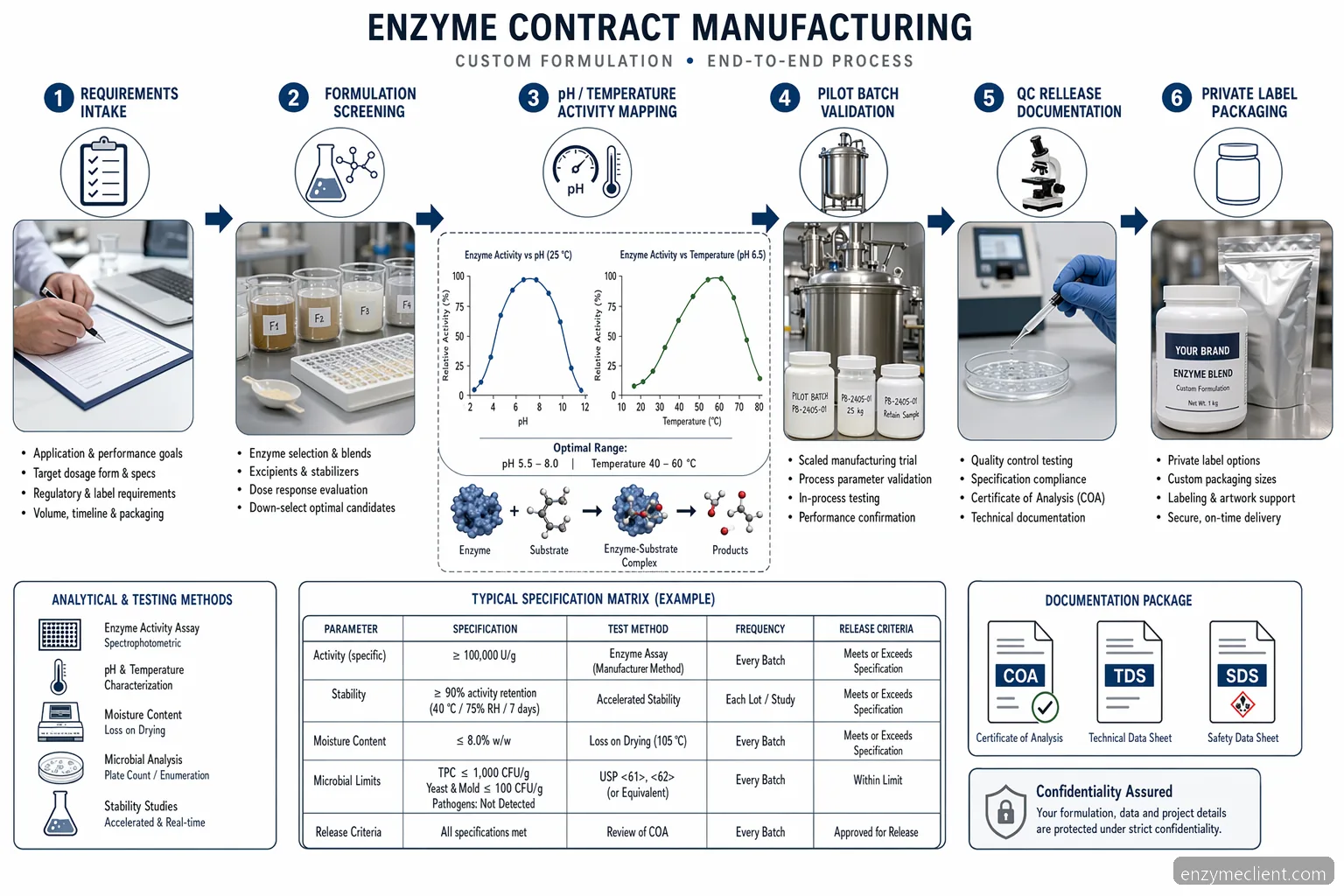
A well-managed enzyme OEM workflow moves from feasibility sample to pilot batch, then to locked specification and recurring manufacture. For industrial enzyme contract manufacturing private label projects, the process typically includes project intake, formulation brief, lab prototypes, stability checks, pilot production, packaging confirmation, release testing, and commercial batch scheduling. The manufacturer should document raw material lots, in-process additions, mixing time, filtration or sieving steps, fill weights, packaging components, and retain samples. For industrial custom enzyme formulation private label supply, artwork and label claims should be reviewed against the agreed TDS and intended application; unsupported performance claims should be avoided. Buyers should ask how the supplier manages formulation changes, alternate raw materials, lead times, minimum order quantities, and emergency production capacity before committing to a recurring supply program.
Require written approval before raw material or process changes. • Confirm minimum order quantities and standard lead times. • Separate technical performance claims from marketing claims.
QC Documentation: COA, TDS, SDS, and Release Criteria
Quality control should be defined before purchase orders are placed. Each commercial lot should ship with a COA listing product name, batch number, manufacture or release date, activity assay result, appearance, pH if applicable, moisture or solids where relevant, and any agreed microbiological or impurity checks. The TDS should describe product form, recommended dosage range, storage conditions, handling precautions, and application guidance. The SDS should cover safe handling, exposure controls, transport information where applicable, and disposal considerations. Depending on use, release testing may include enzyme activity, pH, viscosity, specific gravity, particle size, moisture, total plate count, yeast and mold, absence of specified organisms, and packaging integrity. Buyers should confirm assay methods, acceptance ranges, sample retention period, deviation handling, and how out-of-specification results are investigated.
Request COA, TDS, and SDS before first commercial shipment. • Agree on activity assay method and acceptance range. • Confirm retain sample policy and deviation reporting.
Pilot Validation and Cost-in-Use Analysis
Pilot validation is the bridge between promising lab data and a supply-ready custom enzyme formulation. A disciplined trial compares the candidate enzyme against a control under normal plant conditions, including the same substrate variability, water quality, temperature profile, pH adjustment, contact time, and downstream separation or rinsing steps. Measurements may include conversion yield, viscosity reduction, release of soluble solids, cleaning score, filtration rate, processing time, wastewater load, or energy reduction, depending on the application. The buyer should calculate cost-in-use by considering dosage, activity retention, labor, cycle time, waste, rework, freight, storage, and dilution losses. An enzyme contract manufacturing supplier for private label should support pilot batch quantities, application notes, and practical troubleshooting without overstating results. Successful validation should end with frozen specifications, packaging approval, and a scale-up plan.
Run trials against a no-enzyme or incumbent benchmark. • Track performance, dosage, process time, and total operating cost. • Lock specifications only after repeatable pilot results.
How to Qualify an Enzyme Contract Manufacturing Supplier
Supplier qualification should cover technical capability, manufacturing controls, documentation discipline, and commercial reliability. Buyers comparing industrial enzyme contract manufacturing custom formulation options should review formulation experience, equipment fit, batch size range, raw material traceability, allergen or sensitizer handling practices, cleaning procedures, pest control, complaint handling, and change control. Ask for representative COA templates, TDS examples, SDS availability, process flow summaries, and evidence of batch record review. For custom enzyme formulation supplier for private label programs, confirm confidentiality controls, customer-owned formulation handling, label review workflow, and continuity planning for key raw materials. Commercial qualification should include lead time, forecast process, payment terms, sample policy, technical support access, and escalation contacts. The strongest choice is the supplier that can demonstrate repeatable performance, transparent communication, and controlled scale-up.
Audit change control, traceability, and batch review practices. • Confirm confidentiality terms for customer-owned formulas. • Evaluate technical support as part of supplier qualification.
Technical Buying Checklist
Buyer Questions
Provide the target substrate, application goal, current process conditions, pH, temperature, contact time, equipment limits, dosage target, packaging needs, annual volume, and any restricted ingredients. Share benchmark data if available, such as yield, cleaning performance, viscosity reduction, or cycle time. The more complete the process brief, the faster a supplier can propose prototypes, pilot quantities, QC tests, and realistic cost-in-use expectations.
Yes, many industrial buyers prefer one supplier for formulation, manufacturing, filling, documentation, and private label support. The supplier should be able to develop the enzyme blend, validate pilot batches, manufacture repeatable lots, provide COA/TDS/SDS, and pack into agreed containers. For private label supply, confirm label review, confidentiality, customer-owned formula handling, change control, and batch traceability before launch.
Dosage is usually optimized through lab and pilot trials using activity-based comparisons, not only product weight. A trial may screen several concentrations across the actual process pH, temperature, and contact time. Cost-in-use includes enzyme dose, activity retention, processing time, yield improvement, waste reduction, rework, freight, storage, and labor. The best formulation is often the one that delivers the lowest validated operating cost.
At minimum, request a COA for the specific batch, a current TDS, and an SDS. The COA should list batch number, activity assay result, appearance, and agreed release checks such as pH, moisture, viscosity, microbial limits, or packaging inspection. Buyers should also confirm assay methods, acceptance ranges, retain sample policy, deviation reporting, and change notification procedures before recurring production.
Timelines vary by complexity, raw material availability, testing requirements, and packaging needs. A straightforward blend may move from lab sample to pilot batch in weeks, while a complex stabilized liquid, granule, or private label program can take longer. Build time for prototype screening, stability review, pilot validation, documentation approval, packaging qualification, and first commercial batch release into the sourcing plan.
Related Search Themes
industrial enzyme contract manufacturing custom formulation, enzyme contract manufacturing supplier for custom formulation, industrial enzyme contract manufacturing private label, industrial custom enzyme formulation private label, industrial custom enzyme formulation custom formulation, enzyme contract manufacturing supplier for private label
Lipase (Thermostable) for Research & Industry
Need Lipase (Thermostable) for your lab or production process?
ISO 9001 certified · Food-grade & research-grade · Ships to 80+ countries
Frequently Asked Questions
What information should I provide to request enzyme contract manufacturing for custom formulation?
Provide the target substrate, application goal, current process conditions, pH, temperature, contact time, equipment limits, dosage target, packaging needs, annual volume, and any restricted ingredients. Share benchmark data if available, such as yield, cleaning performance, viscosity reduction, or cycle time. The more complete the process brief, the faster a supplier can propose prototypes, pilot quantities, QC tests, and realistic cost-in-use expectations.
Can one supplier handle both custom formulation and private label enzymes?
Yes, many industrial buyers prefer one supplier for formulation, manufacturing, filling, documentation, and private label support. The supplier should be able to develop the enzyme blend, validate pilot batches, manufacture repeatable lots, provide COA/TDS/SDS, and pack into agreed containers. For private label supply, confirm label review, confidentiality, customer-owned formula handling, change control, and batch traceability before launch.
How are enzyme dosage and cost-in-use determined?
Dosage is usually optimized through lab and pilot trials using activity-based comparisons, not only product weight. A trial may screen several concentrations across the actual process pH, temperature, and contact time. Cost-in-use includes enzyme dose, activity retention, processing time, yield improvement, waste reduction, rework, freight, storage, and labor. The best formulation is often the one that delivers the lowest validated operating cost.
What QC documents should come with an industrial enzyme batch?
At minimum, request a COA for the specific batch, a current TDS, and an SDS. The COA should list batch number, activity assay result, appearance, and agreed release checks such as pH, moisture, viscosity, microbial limits, or packaging inspection. Buyers should also confirm assay methods, acceptance ranges, retain sample policy, deviation reporting, and change notification procedures before recurring production.
How long does custom enzyme formulation scale-up take?
Timelines vary by complexity, raw material availability, testing requirements, and packaging needs. A straightforward blend may move from lab sample to pilot batch in weeks, while a complex stabilized liquid, granule, or private label program can take longer. Build time for prototype screening, stability review, pilot validation, documentation approval, packaging qualification, and first commercial batch release into the sourcing plan.
Related: Custom Enzyme Formulation for Demanding Process Lines
Turn This Guide Into a Supplier Brief Contact enzymeclient.com to discuss a custom enzyme formulation, pilot batch, private label program, or enzyme OEM supply plan. See our application page for Custom Enzyme Formulation for Demanding Process Lines at /applications/custom-enzyme-formulation-faqs/ for specs, MOQ, and a free 50 g sample.
Contact Us to Contribute