Custom Enzyme Formulation FAQs for Industrial Buyers — Supplier Guide
B2B guide to custom enzyme formulation, private label, OEM, pilot validation, QC, COA/TDS/SDS, and cost-in-use for industrial buyers.

A practical process guide for procurement, R&D, and operations teams evaluating custom enzyme formulation, enzyme OEM, and private label enzyme supply.
What Custom Enzyme Formulation Means in B2B Supply
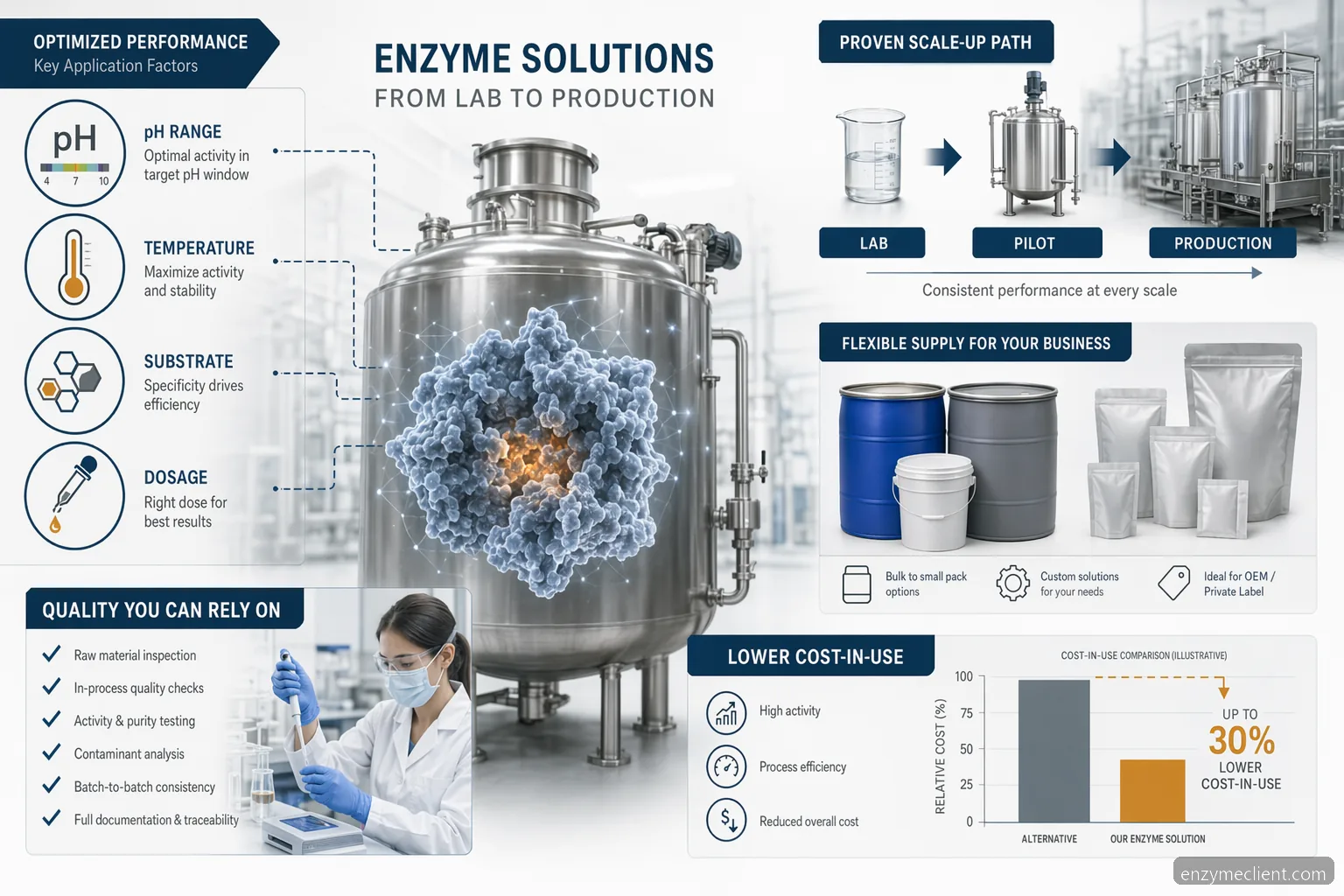
Custom enzyme formulation is the development of an enzyme blend, concentration, carrier system, and finished format for a defined industrial process. For B2B buyers, it is not simply choosing an enzyme activity from a catalog. The supplier should translate your substrate, process water chemistry, pH, temperature, residence time, equipment limits, and regulatory handling requirements into a practical formula. Typical projects may involve liquid concentrates, stabilized powders, granules, or private label finished products. In an enzyme contract manufacturing for custom formulation project, the goal is repeatable performance at the lowest practical cost-in-use, not the highest label activity. A good brief includes current process conditions, pain points, target improvement, unacceptable ingredients, packaging needs, and expected annual volume. This allows the formulation team to recommend a pilot plan, analytical methods, and a commercial specification before scale-up.
Common formats: liquid, powder, granule, slurry, or blend. • Typical buyers: manufacturers, distributors, OEMs, and toll processors. • Key documents: COA, TDS, SDS, specification, and batch record summary.
Critical Process Conditions to Share Before Quotation
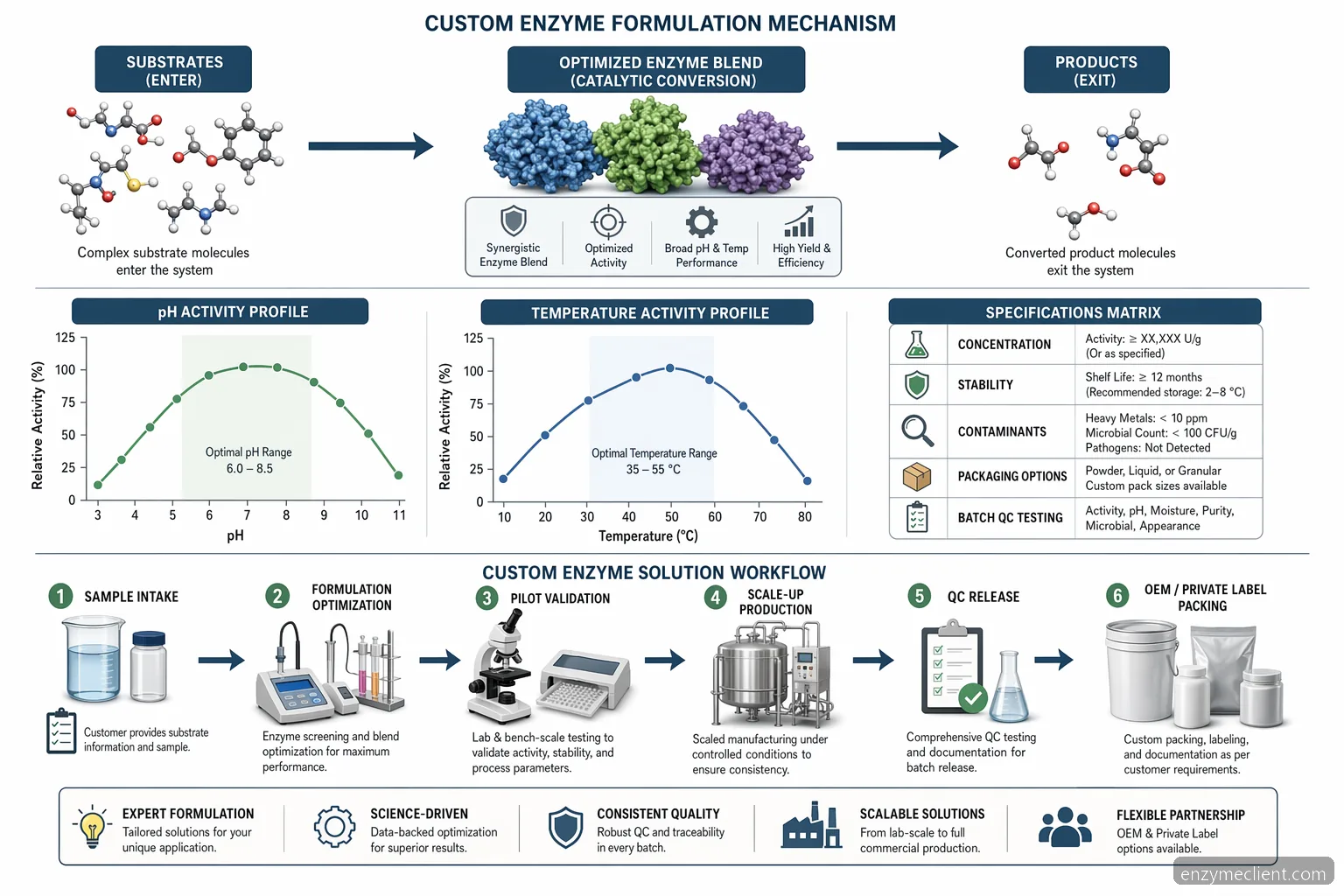
Accurate process data shortens development time and reduces reformulation risk. Most industrial enzyme systems are sensitive to pH, temperature, surfactants, oxidizers, solvents, salts, metals, and shear. For many applications, useful screening ranges start around pH 4.0 to 9.5 and 20°C to 65°C, but the final recommendation depends on enzyme class and substrate. Some proteases tolerate alkaline conditions, while certain cellulases or amylases may perform best closer to mild acidic or neutral ranges. Dosage bands are usually screened as a percentage of substrate, product weight, or process liquor, such as 0.01% to 1.0% w/w, then refined during pilot validation. An enzyme contract manufacturing supplier for custom formulation should ask for batch size, hold time, cleaning chemistry, storage conditions, and any downstream compatibility constraints before pricing.
Report normal, minimum, and maximum pH. • List operating and cleaning temperatures separately. • Identify oxidizers, preservatives, biocides, surfactants, or solvents. • Share current dosage, cycle time, and performance baseline.
Pilot Validation and Scale-Up Expectations
Pilot validation connects lab performance to commercial reliability. A supplier offering custom enzyme formulation supplier for custom formulation support should propose a test matrix that compares candidate blends against your current process and a no-enzyme control. Useful measurements may include viscosity reduction, release of target sugars, stain or soil removal, fiber modification, protein hydrolysis, yield increase, filtration rate, or cleaning efficiency, depending on the application. Testing should use realistic water quality, substrate variation, mixing intensity, contact time, and temperature. Scale-up should also verify pumpability, foaming, dosing accuracy, storage stability, and compatibility with packaging. Activity loss during storage can be assessed at ambient and accelerated conditions, for example 25°C and 35°C to 40°C where appropriate. The outcome should be a defined commercial specification, recommended dosage window, QC release tests, and cost-in-use estimate.
Run lab, bench, and pilot stages before commercial launch. • Confirm performance on real plant substrates, not idealized samples. • Use dosage-response curves to avoid over-formulation. • Document acceptance criteria before the trial begins.
Private Label and OEM Enzyme Manufacturing
Industrial custom enzyme formulation private label programs require both technical fit and supply-chain discipline. The finished product may carry a customer label, but the underlying specification must still define enzyme activity, physical form, appearance, pH, density or bulk density, microbial limits where relevant, packaging, shelf life, and storage conditions. For custom enzyme formulation for private label projects, buyers should confirm who owns the formula, who approves label claims, what change notification period applies, and how retained samples are managed. Enzyme OEM supply may also require neutral drums, totes, pails, sachets, or bulk bags. A custom enzyme formulation supplier for private label should support artwork inputs, lot coding requirements, SDS alignment, and documentation needed by downstream industrial customers. The best commercial structure balances minimum order quantity, lead time, inventory risk, and forecast flexibility.
Define label responsibility and claim approval early. • Agree on packaging sizes, closures, liners, and pallet configuration. • Confirm formula ownership and change-control expectations. • Set forecast, safety stock, and lead-time assumptions.
Supplier Qualification, QC, and Cost-in-Use
Supplier qualification should cover technical capability, manufacturing controls, documentation quality, and responsiveness. Request recent examples of similar industrial custom enzyme formulation custom formulation work, without expecting disclosure of confidential customer formulas. At minimum, evaluate COA content, TDS clarity, SDS completeness, lot traceability, allergen or sensitizer handling statements where applicable, retained sample policy, deviation handling, and change-control process. QC checks commonly include enzyme activity assay, pH, appearance, moisture or solids, density or bulk density, viscosity for liquids, particle size for powders, and microbial indicators when relevant to the product type. Commercial comparison should focus on cost-in-use: dosage required, performance gain, waste reduction, cycle-time impact, freight, storage stability, and handling losses. The lowest price per kilogram may not be the lowest process cost if activity, stability, or dosing efficiency is inferior.
Compare cost per treated unit, not only unit price. • Review COA, TDS, and SDS before approval. • Confirm lot traceability and change notification. • Include freight, storage, and dosing losses in economics.
Technical Buying Checklist
Buyer Questions
Share the substrate, process flow, pH, temperature, contact time, batch size, current chemistry, target improvement, and any restricted ingredients. Include samples when possible, plus desired format, packaging, annual volume, and launch timing. For industrial enzyme contract manufacturing custom formulation work, the supplier also needs performance criteria so the pilot can measure cost-in-use, not just lab activity.
Timelines depend on complexity, sample availability, and validation requirements. A straightforward reformulation may move from brief to pilot sample in a few weeks, while a new blend with stability, compatibility, and private label packaging can take longer. Buyers should plan for lab screening, pilot validation, documentation review, packaging approval, and first-article production before full commercial release.
At minimum, request a COA for each lot, a TDS describing product properties and use guidance, and an SDS for safe handling. For supplier qualification, also review specification limits, activity assay method, storage recommendations, lot traceability, retained sample policy, and change-control process. These documents help procurement, EHS, quality, and production teams approve the material consistently.
Cost-in-use combines price, dosage, activity retention, process yield, cycle time, rework, waste, freight, and handling losses. A higher-priced enzyme concentrate can be more economical if it works at a lower dose or improves throughput. The best comparison uses pilot data from your substrate and process conditions, with dosage-response curves and clear acceptance criteria.
Yes, if the supplier has suitable formulation, manufacturing, packaging, documentation, and lot-control capabilities. For industrial custom enzyme formulation private label projects, confirm label inputs, SDS alignment, ownership of the formulation, change notification, packaging configuration, lead time, and minimum order quantity. A custom enzyme formulation supplier for private label should also support release testing and retained samples.
Related Search Themes
industrial enzyme contract manufacturing custom formulation, industrial custom enzyme formulation private label, industrial custom enzyme formulation custom formulation, enzyme contract manufacturing supplier for custom formulation, enzyme contract manufacturing for custom formulation, custom enzyme formulation supplier for private label
Lipase (Thermostable) for Research & Industry
Need Lipase (Thermostable) for your lab or production process?
ISO 9001 certified · Food-grade & research-grade · Ships to 80+ countries
Frequently Asked Questions
What information is needed to start a custom enzyme formulation project?
Share the substrate, process flow, pH, temperature, contact time, batch size, current chemistry, target improvement, and any restricted ingredients. Include samples when possible, plus desired format, packaging, annual volume, and launch timing. For industrial enzyme contract manufacturing custom formulation work, the supplier also needs performance criteria so the pilot can measure cost-in-use, not just lab activity.
How long does enzyme contract manufacturing for custom formulation usually take?
Timelines depend on complexity, sample availability, and validation requirements. A straightforward reformulation may move from brief to pilot sample in a few weeks, while a new blend with stability, compatibility, and private label packaging can take longer. Buyers should plan for lab screening, pilot validation, documentation review, packaging approval, and first-article production before full commercial release.
What QC documents should an industrial enzyme supplier provide?
At minimum, request a COA for each lot, a TDS describing product properties and use guidance, and an SDS for safe handling. For supplier qualification, also review specification limits, activity assay method, storage recommendations, lot traceability, retained sample policy, and change-control process. These documents help procurement, EHS, quality, and production teams approve the material consistently.
How is cost-in-use calculated for a custom enzyme formula?
Cost-in-use combines price, dosage, activity retention, process yield, cycle time, rework, waste, freight, and handling losses. A higher-priced enzyme concentrate can be more economical if it works at a lower dose or improves throughput. The best comparison uses pilot data from your substrate and process conditions, with dosage-response curves and clear acceptance criteria.
Can a supplier support private label enzymes and enzyme OEM programs?
Yes, if the supplier has suitable formulation, manufacturing, packaging, documentation, and lot-control capabilities. For industrial custom enzyme formulation private label projects, confirm label inputs, SDS alignment, ownership of the formulation, change notification, packaging configuration, lead time, and minimum order quantity. A custom enzyme formulation supplier for private label should also support release testing and retained samples.
Related: Custom Enzyme Formulation for Demanding Process Lines
Turn This Guide Into a Supplier Brief Request a custom enzyme formulation review with process details, target performance, and packaging needs. See our application page for Custom Enzyme Formulation for Demanding Process Lines at /applications/custom-enzyme-formulation-faqs/ for specs, MOQ, and a free 50 g sample.
Contact Us to Contribute