Custom Enzyme Formulation Supplier for Custom Formulation
Source industrial custom enzyme formulation for custom formulation and private label programs, with pilot validation, COA/TDS/SDS, and cost-in-use support.

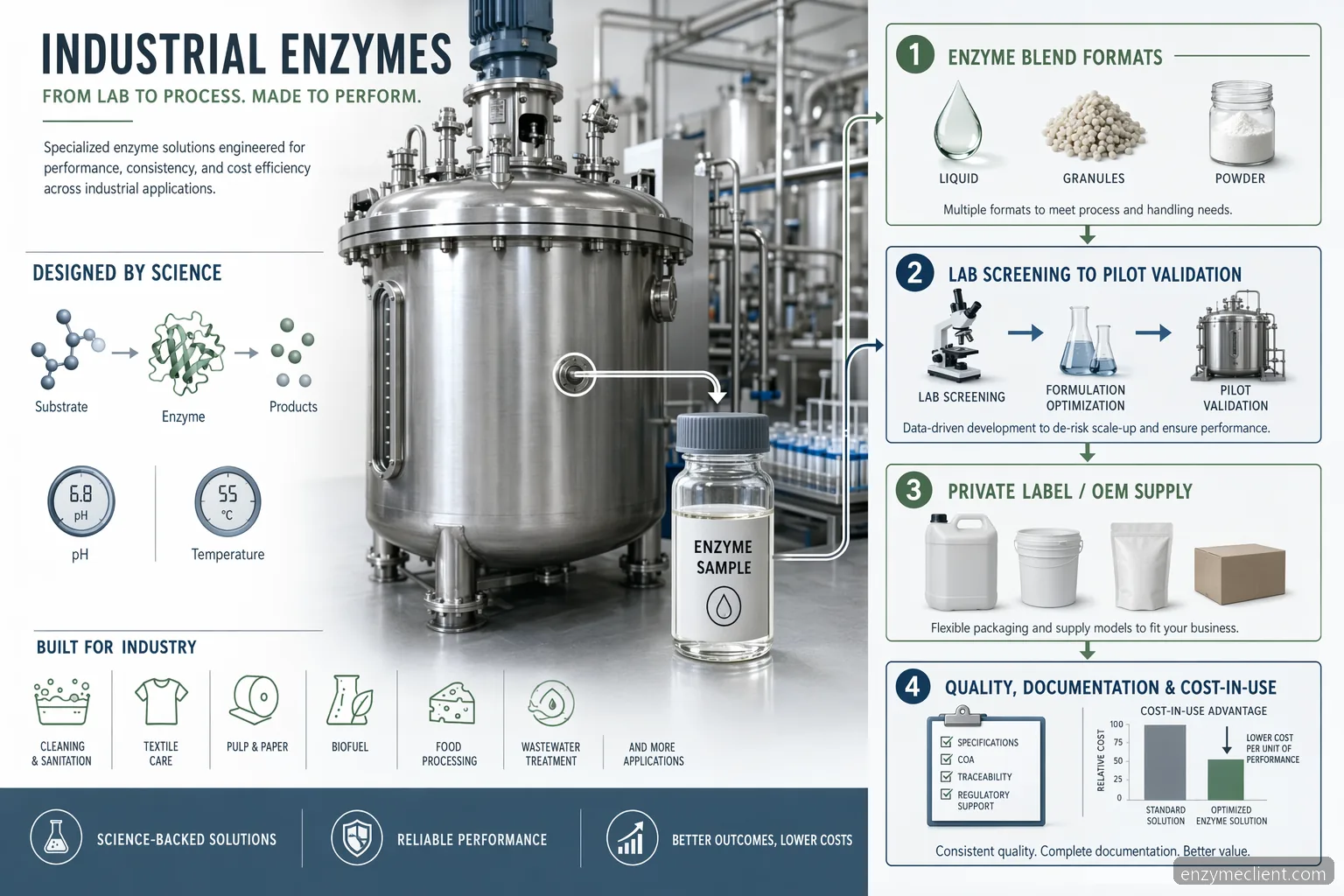
Develop fit-for-process enzyme blends, liquids, granulates, and private label formats with technical support from lab screening through pilot validation and scale-up.
Industrial Enzyme Formulation Starts with the Process
A custom enzyme formulation supplier for custom formulation should begin with the buyer’s process map, not a catalog recommendation. Industrial applications may require protease, amylase, cellulase, lipase, xylanase, pectinase, mannanase, or multi-enzyme systems, but the right choice depends on substrate, contact time, water activity, shear, inhibitors, and downstream compatibility. For many aqueous processes, initial screening is commonly run across pH 4.0-9.5 and 25-65°C, then narrowed to the true operating window. Dosage studies often start in broad bands such as 0.01-1.0% w/w of finished product or 50-5,000 activity units per gram of substrate, depending on the assay method. A technical supplier should translate these trials into a stable commercial format: liquid concentrate, buffered blend, spray-dried powder, granule, or soluble packet. This approach supports industrial custom enzyme formulation custom formulation projects where performance, handling, and shelf life must be balanced.
Define substrate type, solids level, pH, temperature, and contact time before enzyme selection. • Screen single enzymes before building synergistic blends. • Confirm compatibility with preservatives, surfactants, salts, solvents, and processing aids. • Select the final format based on dosing equipment, dust control, storage, and customer labeling needs.
From Lab Prototype to Pilot Validation
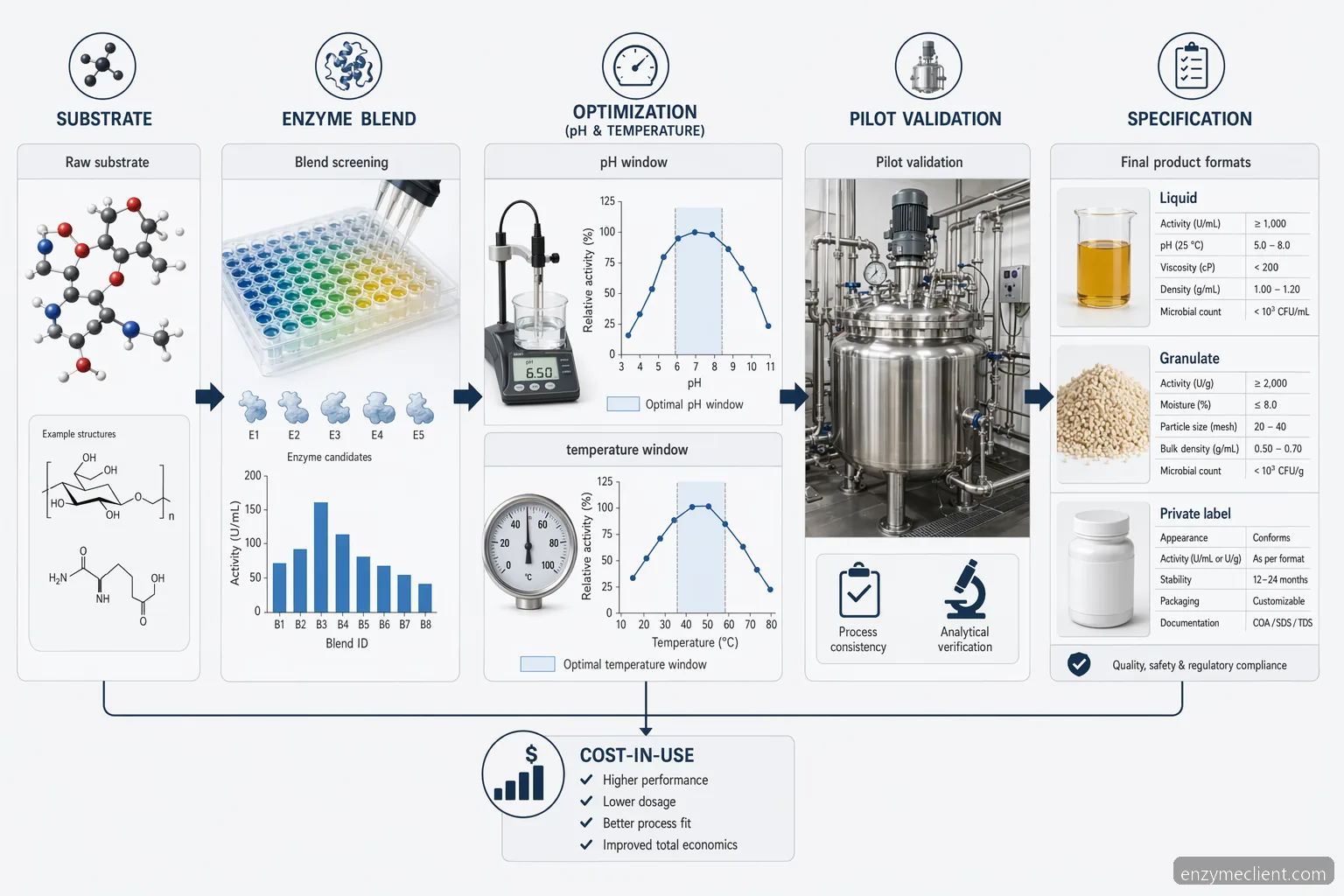
For enzyme contract manufacturing for custom formulation, a reliable development path includes bench screening, prototype optimization, pilot validation, and controlled production transfer. Bench work should use the customer’s actual raw materials where possible because enzyme response can shift with crop variation, fiber content, protein denaturation, minerals, or residual cleaning chemicals. After a lead formula is selected, pilot batches should confirm mixing order, hydration time, filtration behavior, viscosity, foam tendency, and activity retention after holding. Typical pilot checks include pre- and post-processing enzyme activity, pH drift, microbial limits where relevant, appearance, odor, moisture for powders, and density for liquids. Packaging trials can test high-density polyethylene drums, intermediate bulk containers, foil-lined bags, or moisture-barrier sachets. A strong industrial enzyme contract manufacturing custom formulation partner documents each change, preserves retained samples, and establishes acceptance criteria before commercial release. This reduces surprises when the process moves from kilogram prototypes to multi-batch supply.
Run pilot trials at the same pH, temperature, shear, and hold time expected in production. • Measure retained activity after processing and after short-term storage stress. • Document raw material lots, batch records, and change-control decisions. • Use pilot data to set realistic specifications and release limits.
Private Label and OEM Enzyme Supply
Buyers seeking a custom enzyme formulation supplier for private label need more than blending capacity. Private label enzymes supplier for custom formulation projects require confidentiality, repeatable documentation, packaging flexibility, and practical support for customer-facing technical files. Enzyme OEM programs may involve a buyer-owned formula, a jointly developed blend, or a supplier-developed formulation packed under the buyer’s label. In each case, responsibilities should be clear: who owns the formula, who approves raw material substitutions, who maintains the technical data sheet, and who controls label content. Industrial custom enzyme formulation private label programs also need stable packaging that protects activity from heat, moisture, oxygen, and contamination. Liquid enzymes may need buffering, preservatives appropriate to the market, and freeze-thaw review. Powder enzymes may need anti-caking systems, dust-reduced granulation, or moisture-controlled packing. Properly managed, custom enzyme formulation for private label enables brand owners to expand product lines without building enzyme production infrastructure.
Clarify formula ownership, confidentiality, and non-disclosure expectations. • Align label claims with validated performance data and applicable market rules. • Choose pack sizes for toll blending, repacking, distribution, or end-user dosing. • Maintain version-controlled TDS, SDS, COA templates, and batch records.
Quality Documentation Buyers Should Request
Supplier qualification should verify both technical competence and quality discipline. At minimum, request a certificate of analysis for each batch, a technical data sheet describing activity units and application guidance, and a safety data sheet for safe handling and storage. The COA should identify batch number, manufacturing or release date, activity result, specification range, appearance, and other agreed QC checks. For powders, common checks include moisture, particle size, bulk density, and retained activity. For liquids, checks may include pH, density, viscosity, microbial indicators where appropriate, and activity after processing. Buyers should also review allergen or sensitizer handling statements where relevant to the application, because enzyme dust and aerosols require workplace controls. An enzyme contract manufacturing supplier for custom formulation should provide traceability, change notification practices, retained sample policy, complaint investigation process, and reasonable audit support. Documentation does not replace testing, but it helps procurement, R&D, EHS, and quality teams approve the supplier.
Request COA, TDS, SDS, lot traceability, and storage guidance before purchasing. • Confirm the activity assay method and unit definition used for release. • Review retained sample policy and expected shelf-life monitoring. • Evaluate supplier change-control and notification procedures.
Calculate Cost-in-Use Before Selecting a Formula
The lowest price per kilogram is rarely the best measure for custom enzyme formulation. Cost-in-use compares the enzyme dose required to achieve a validated result, including yield improvement, cycle time reduction, lower processing temperature, reduced rework, or simpler downstream separation. During trials, compare formulas at matched activity dose and at practical production dose. For example, two blends may look similar at 0.10% addition, but one may retain more activity at pH 6.5 and 55°C after a two-hour hold. Another may disperse faster, reduce mixing time, or require less preservative support. Procurement should evaluate unit cost, freight, shelf life, storage temperature, minimum order quantity, packaging waste, and batch-to-batch consistency. R&D should evaluate response curves, stability, and robustness to raw material variation. A qualified supplier can model these factors and recommend a formulation that fits both plant economics and technical performance.
Compare formulas by performance per activity unit and per production batch. • Include storage, freight, handling, waste, and shelf-life losses in cost models. • Use pilot data to verify response curves before signing supply agreements. • Select the formula that gives reliable performance under real operating variation.
Technical Buying Checklist
Buyer Questions
Provide the target application, substrate or soil type, process pH, temperature, contact time, solids level, water activity, mixing conditions, and any incompatible ingredients. Share desired format, dosage target, packaging, labeling needs, and annual volume estimate. If possible, supply raw material samples and current performance data so the supplier can design meaningful screening and pilot validation work.
Activity is usually confirmed with an assay matched to the enzyme class and substrate. The supplier should define the unit, test method, sample preparation, and release specification on the COA or supporting quality documents. For blends, individual activities may be tested separately where practical, while performance assays can confirm the finished formulation under realistic pH, temperature, and contact-time conditions.
Yes. A supplier can support private label enzymes or enzyme OEM supply by developing or manufacturing a formula that is packed under the buyer’s label. The agreement should define formula ownership, confidentiality, approved raw materials, packaging specifications, label responsibilities, documentation requirements, and change-control rules. Pilot batches should validate that the private label format performs consistently after storage and distribution.
Cost-in-use measures the total economic effect of the formulation in production. It includes dosage, retained activity, yield, cycle time, rework reduction, storage losses, freight, and handling costs. A higher-priced enzyme blend may be more economical if it performs at a lower dose, stays stable at the process pH and temperature, or reduces downstream processing issues.
Request a current TDS, SDS, sample COA, specification sheet, storage guidance, shelf-life expectations, and a description of QC release testing. For commercial supply, confirm batch traceability, retained sample policy, change notification practice, complaint handling, and packaging specifications. These documents help procurement, quality, EHS, and R&D teams assess whether the supplier can support repeatable industrial production.
Related Search Themes
enzyme contract manufacturing supplier for custom formulation, custom enzyme formulation supplier for private label, private label enzymes supplier for custom formulation, industrial enzyme contract manufacturing custom formulation, industrial custom enzyme formulation private label, industrial custom enzyme formulation custom formulation
Lipase (Thermostable) for Research & Industry
Need Lipase (Thermostable) for your lab or production process?
ISO 9001 certified · Food-grade & research-grade · Ships to 80+ countries
Frequently Asked Questions
What information should we provide to start a custom enzyme formulation project?
Provide the target application, substrate or soil type, process pH, temperature, contact time, solids level, water activity, mixing conditions, and any incompatible ingredients. Share desired format, dosage target, packaging, labeling needs, and annual volume estimate. If possible, supply raw material samples and current performance data so the supplier can design meaningful screening and pilot validation work.
How is enzyme activity confirmed for a custom formulation?
Activity is usually confirmed with an assay matched to the enzyme class and substrate. The supplier should define the unit, test method, sample preparation, and release specification on the COA or supporting quality documents. For blends, individual activities may be tested separately where practical, while performance assays can confirm the finished formulation under realistic pH, temperature, and contact-time conditions.
Can an enzyme formulation be supplied for private label or OEM use?
Yes. A supplier can support private label enzymes or enzyme OEM supply by developing or manufacturing a formula that is packed under the buyer’s label. The agreement should define formula ownership, confidentiality, approved raw materials, packaging specifications, label responsibilities, documentation requirements, and change-control rules. Pilot batches should validate that the private label format performs consistently after storage and distribution.
What makes cost-in-use different from enzyme price per kilogram?
Cost-in-use measures the total economic effect of the formulation in production. It includes dosage, retained activity, yield, cycle time, rework reduction, storage losses, freight, and handling costs. A higher-priced enzyme blend may be more economical if it performs at a lower dose, stays stable at the process pH and temperature, or reduces downstream processing issues.
What documents should we request before approving a supplier?
Request a current TDS, SDS, sample COA, specification sheet, storage guidance, shelf-life expectations, and a description of QC release testing. For commercial supply, confirm batch traceability, retained sample policy, change notification practice, complaint handling, and packaging specifications. These documents help procurement, quality, EHS, and R&D teams assess whether the supplier can support repeatable industrial production.
Related: Custom Enzyme Formulation for Demanding Process Lines
Turn This Guide Into a Supplier Brief Send your process conditions and target format to request a custom enzyme formulation review, pilot plan, and supply proposal. See our application page for Custom Enzyme Formulation for Demanding Process Lines at /applications/custom-enzyme-formulation-faqs/ for specs, MOQ, and a free 50 g sample.
Contact Us to Contribute