Enzyme Contract Manufacturing Supplier for Custom Formulation
Process guide for B2B buyers sourcing custom enzyme formulation, private label enzymes, pilot validation, QC, COA/TDS/SDS, and cost-in-use.

A practical B2B guide for industrial buyers evaluating custom enzyme formulation, private label enzymes, and OEM manufacturing support.
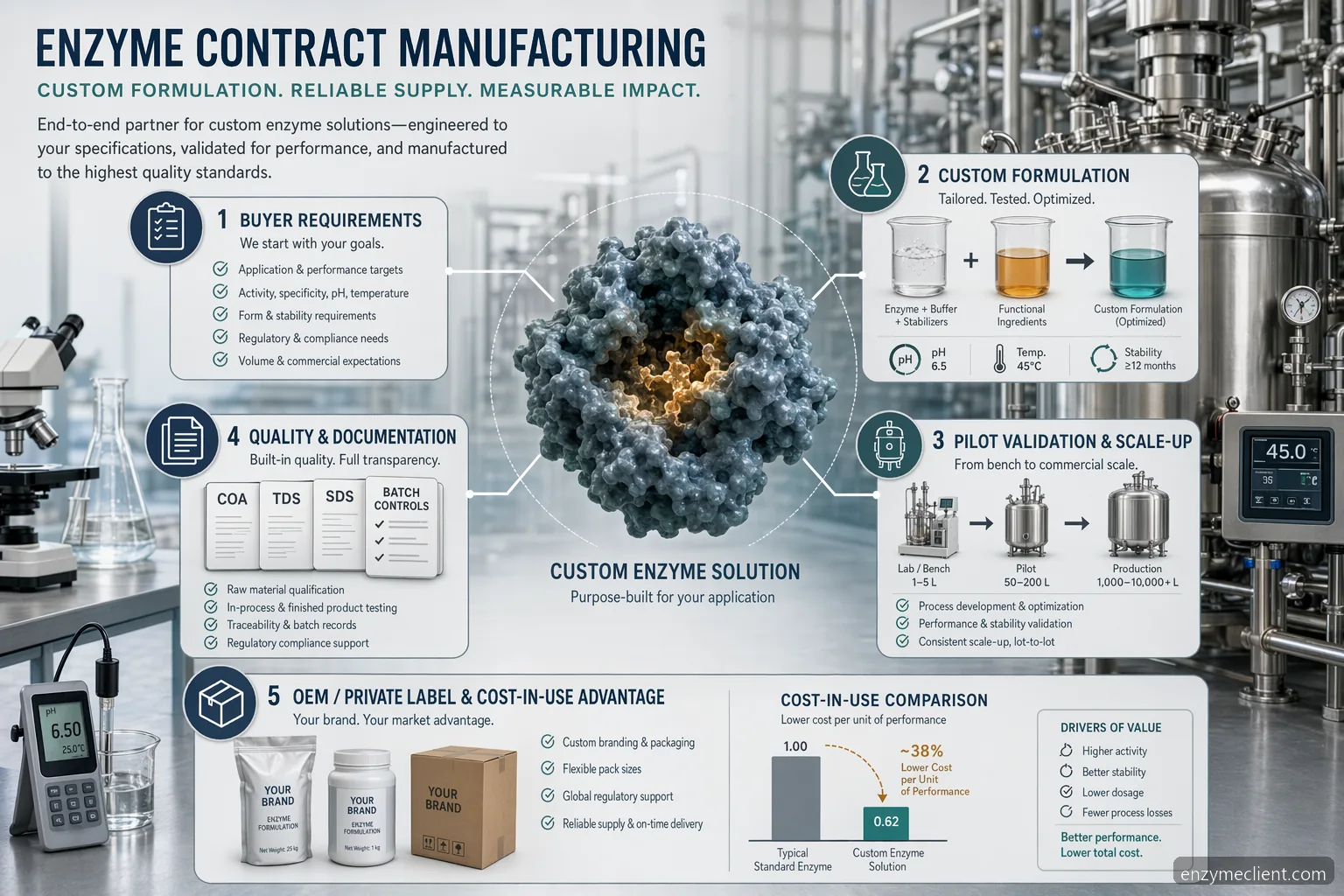
What Industrial Buyers Need From a Custom Enzyme Partner
An enzyme contract manufacturing supplier for custom formulation should do more than blend a standard liquid or powder. Industrial buyers typically need a partner that can translate process conditions into a stable, measurable, and commercially usable enzyme product. That starts with application data: substrate type, solids level, process water quality, pH, operating temperature, contact time, cleaning constraints, and target performance. For many industrial enzyme applications, useful screening windows may include pH 4.0-9.0, temperatures from 25-65°C, and dosage bands from 0.01-1.0% by weight, depending on enzyme class and substrate load. The supplier should help refine those ranges rather than assume one generic dose works everywhere. This page is focused on B2B industrial uses such as custom formulation and private label supply, not medical, dietary supplement, or therapeutic advice.
Clarify whether the product will be liquid, granulated, powder, or stabilized concentrate. • Confirm intended application conditions before discussing price per kilogram. • Separate performance targets from marketing claims.
A Practical Process for Custom Enzyme Formulation
A disciplined custom enzyme formulation project usually begins with a technical intake, followed by bench screening, prototype formulation, pilot validation, and production transfer. During intake, the buyer should provide current process parameters, incompatible raw materials, preferred packaging, label requirements, and acceptance criteria. Bench work may compare enzyme activity under several pH and temperature points, such as pH 5.5, 7.0, and 8.5 or 30°C, 45°C, and 60°C, depending on the process. Formulation then addresses stabilizers, carriers, preservatives where appropriate, moisture control, dusting risk, viscosity, and storage conditions. A qualified industrial enzyme contract manufacturing custom formulation partner should document assumptions and explain why each excipient or processing step is used. The goal is not simply maximum activity on paper; it is repeatable performance in the buyer’s production environment at an acceptable cost-in-use.
Screen under actual process conditions when possible. • Track activity before and after formulation. • Evaluate stability at expected storage and shipping temperatures.
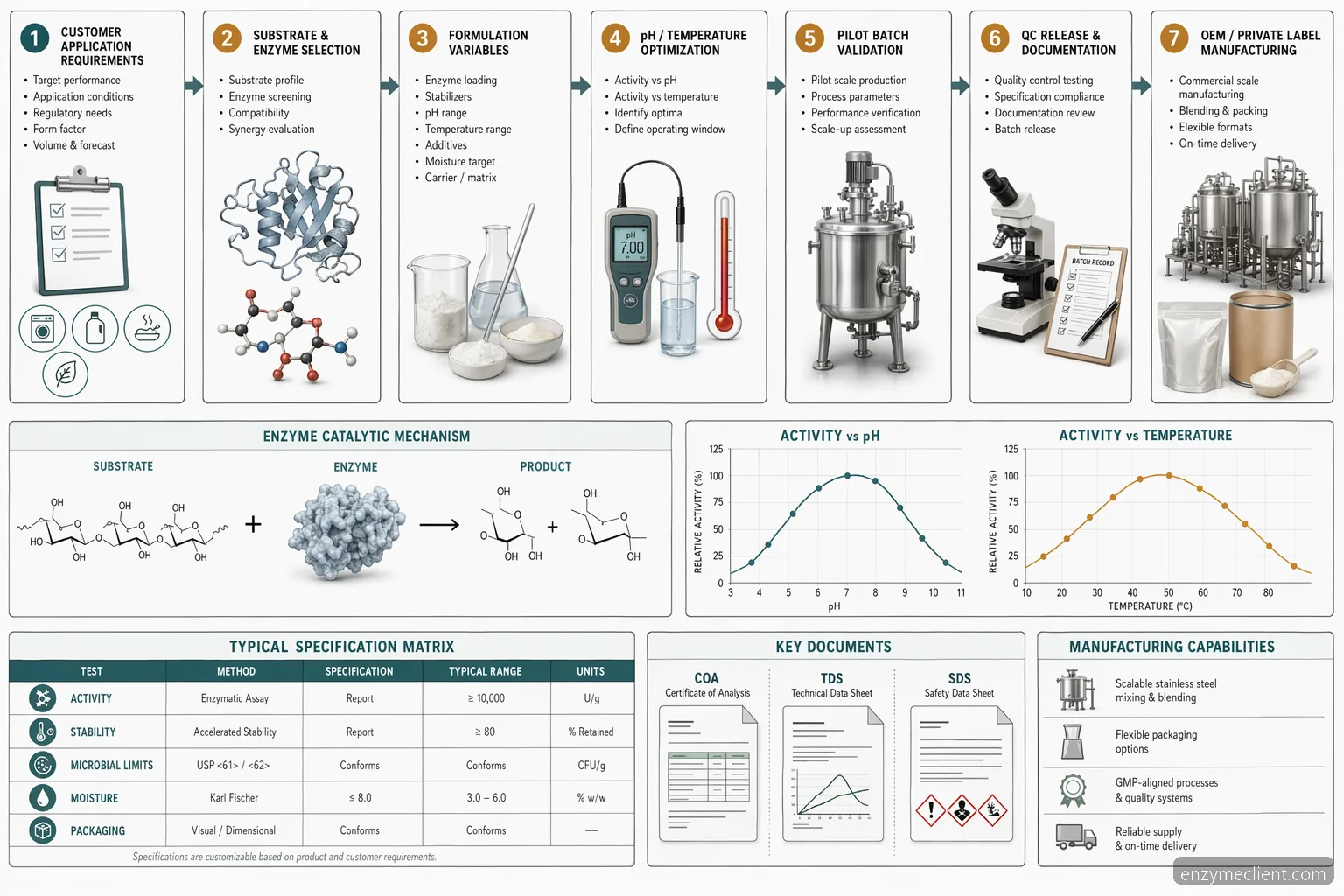
Pilot Validation Before Scale-Up
Pilot validation reduces the risk of moving from a promising lab sample to an expensive commercial batch too quickly. For enzyme contract manufacturing for custom formulation, the pilot should simulate the buyer’s real process as closely as practical, including mixing energy, addition point, hold time, pH drift, thermal exposure, and downstream separation or cleaning. Typical pilot questions include whether the enzyme remains active after 30-120 minutes of contact, whether performance declines above a defined temperature, and whether the formulation causes foaming, precipitation, odor, viscosity change, or filtration issues. Buyers should also calculate cost-in-use during the pilot, not only unit price. A lower-priced enzyme can be more expensive if dosage must double or if process time increases. Pilot reports should include batch number, formulation version, test method, dosage, conditions, performance data, observations, and recommendation for next steps.
Validate dosage bands such as 0.05%, 0.10%, and 0.25% where relevant. • Compare prototype performance against current process baseline. • Document any handling, mixing, or compatibility concerns.
Quality Documents: COA, TDS, SDS, and Batch Controls
A reliable enzyme contract manufacturing supplier for private label programs should provide documentation that supports incoming inspection, regulatory review, and production release. The Certificate of Analysis should identify the lot, manufacture or release date, activity result, test method, appearance, pH where applicable, moisture or solids when relevant, and microbiological limits if specified for the application. The Technical Data Sheet should describe intended industrial use, typical activity range, physical form, recommended handling, storage conditions, and suggested starting dosage. The Safety Data Sheet should communicate safe handling, hazards, storage, accidental release measures, and transport information as applicable. Buyers should also ask how retained samples are stored, how deviations are documented, and how formulation or raw material changes are communicated. Documentation does not replace validation, but weak documentation is often a warning sign during supplier qualification.
Require lot-specific COA for each shipment. • Align test methods before commercial purchase orders. • Maintain version control for TDS, SDS, and private label specifications.
Private Label and OEM Enzyme Manufacturing Considerations
Private label enzymes supplier for custom formulation projects require close control over packaging, labeling, claims language, and confidentiality. Buyers should define container type, fill volume, closure, induction seal or liner needs, tamper-evident features where required, pallet configuration, shelf-life target, and storage statements. For an enzyme OEM program, the supplier may also support neutral branding, buyer-owned specifications, and agreed artwork review, while avoiding unsupported performance claims. Industrial custom enzyme formulation private label projects should include compatibility checks between the formulation and packaging, especially for liquids where pH, preservatives, surfactants, or solvents can affect seals and containers. Powder products may require attention to moisture barrier properties, dust control, and flowability. The commercial agreement should clearly define ownership of custom formulas, change notification timelines, minimum order quantities, lead times, and responsibilities for market-specific compliance review.
Confirm whether the buyer or supplier owns the final formulation specification. • Test packaging under expected storage conditions. • Use approved label text tied to validated performance data.
Supplier Qualification and Cost-in-Use Evaluation
Choosing a custom enzyme formulation supplier for private label or custom formulation should involve both technical and commercial review. Supplier qualification can include a facility questionnaire, process flow review, allergen or cross-contact controls where relevant, raw material traceability, batch record practices, cleaning procedures, complaint handling, and change-control expectations. Buyers should request representative documents before awarding business, including a sample COA, TDS, SDS, specification sheet, and proposed QC plan. Commercial evaluation should compare delivered cost-in-use, not just quoted price. Important variables include enzyme activity, recommended dosage, dilution requirements, storage losses, freight, packaging size, waste, operator handling, and process cycle time. A strong supplier will help quantify these factors and identify the formulation version that gives the best balance of performance, stability, documentation, and manufacturing practicality.
Compare cost per treated ton, batch, or process run. • Ask for change-control commitments before scale-up. • Confirm lead time for repeat orders and emergency replenishment.
Technical Buying Checklist
Buyer Questions
Provide the application, substrate, process pH, temperature, contact time, batch size, current dosage, target result, preferred product form, packaging needs, and any incompatible ingredients. If available, include baseline performance data and the current cost per treated unit. This allows the supplier to recommend realistic screening conditions, avoid unsuitable formulations, and quote based on cost-in-use rather than only price per kilogram.
Timelines depend on complexity, sample availability, testing methods, and packaging requirements. A straightforward formulation adjustment may move through bench screening in a few weeks, while a new private label enzyme program with pilot validation, packaging checks, and document review can take longer. Buyers can shorten timelines by providing complete process data, clear acceptance criteria, and prompt feedback on prototype performance.
Common QC checks include enzyme activity by an agreed method, appearance, odor where relevant, pH for liquids or solutions, moisture for powders, solids or viscosity for liquids, fill weight, packaging integrity, and microbial limits when specified by the application. The COA should report the agreed release parameters and lot identification. The supplier and buyer should align methods before commercial production begins.
Yes, many enzyme contract manufacturing programs can include private label or OEM packaging when requirements are defined early. Buyers should specify container size, closure, label format, pallet pattern, shelf-life target, storage statement, and artwork approval process. The supplier should confirm packaging compatibility, maintain version control, and avoid unsupported claims. Ownership of formulations, labels, and specifications should be addressed in the commercial agreement.
Unit price does not show how the enzyme performs in the process. Cost-in-use accounts for dosage, activity, stability, dilution, freight, storage losses, labor, waste, and any change in cycle time or yield. A higher-priced formulation may be more economical if it works at lower dosage, stores better, or reduces process time. Pilot validation is the best way to compare these factors objectively.
Related Search Themes
industrial enzyme contract manufacturing custom formulation, enzyme contract manufacturing for custom formulation, enzyme contract manufacturing supplier for private label, custom enzyme formulation supplier for private label, custom enzyme formulation supplier for custom formulation, private label enzymes supplier for custom formulation
Lipase (Thermostable) for Research & Industry
Need Lipase (Thermostable) for your lab or production process?
ISO 9001 certified · Food-grade & research-grade · Ships to 80+ countries
Frequently Asked Questions
What information should we provide before requesting a quote?
Provide the application, substrate, process pH, temperature, contact time, batch size, current dosage, target result, preferred product form, packaging needs, and any incompatible ingredients. If available, include baseline performance data and the current cost per treated unit. This allows the supplier to recommend realistic screening conditions, avoid unsuitable formulations, and quote based on cost-in-use rather than only price per kilogram.
How long does custom enzyme formulation usually take?
Timelines depend on complexity, sample availability, testing methods, and packaging requirements. A straightforward formulation adjustment may move through bench screening in a few weeks, while a new private label enzyme program with pilot validation, packaging checks, and document review can take longer. Buyers can shorten timelines by providing complete process data, clear acceptance criteria, and prompt feedback on prototype performance.
What QC checks should be included for industrial enzyme batches?
Common QC checks include enzyme activity by an agreed method, appearance, odor where relevant, pH for liquids or solutions, moisture for powders, solids or viscosity for liquids, fill weight, packaging integrity, and microbial limits when specified by the application. The COA should report the agreed release parameters and lot identification. The supplier and buyer should align methods before commercial production begins.
Can a supplier support private label enzymes and OEM packaging?
Yes, many enzyme contract manufacturing programs can include private label or OEM packaging when requirements are defined early. Buyers should specify container size, closure, label format, pallet pattern, shelf-life target, storage statement, and artwork approval process. The supplier should confirm packaging compatibility, maintain version control, and avoid unsupported claims. Ownership of formulations, labels, and specifications should be addressed in the commercial agreement.
Why is cost-in-use more important than enzyme unit price?
Unit price does not show how the enzyme performs in the process. Cost-in-use accounts for dosage, activity, stability, dilution, freight, storage losses, labor, waste, and any change in cycle time or yield. A higher-priced formulation may be more economical if it works at lower dosage, stores better, or reduces process time. Pilot validation is the best way to compare these factors objectively.
Related: Custom Enzyme Formulation for Demanding Process Lines
Turn This Guide Into a Supplier Brief Discuss your custom enzyme formulation or private label manufacturing project with our technical team. See our application page for Custom Enzyme Formulation for Demanding Process Lines at /applications/custom-enzyme-formulation-faqs/ for specs, MOQ, and a free 50 g sample.
Contact Us to Contribute