Industrial Custom Enzyme Formulation for Custom Formulation
Troubleshoot industrial custom enzyme formulation with dosage, pH, temperature, QC, pilot validation, and private label supply guidance.

For industrial custom enzyme formulation custom formulation projects, performance issues usually trace back to dosage, pH, temperature, substrate variability, or poor validation. This guide helps B2B buyers define process targets before scale-up, private label, or OEM supply.
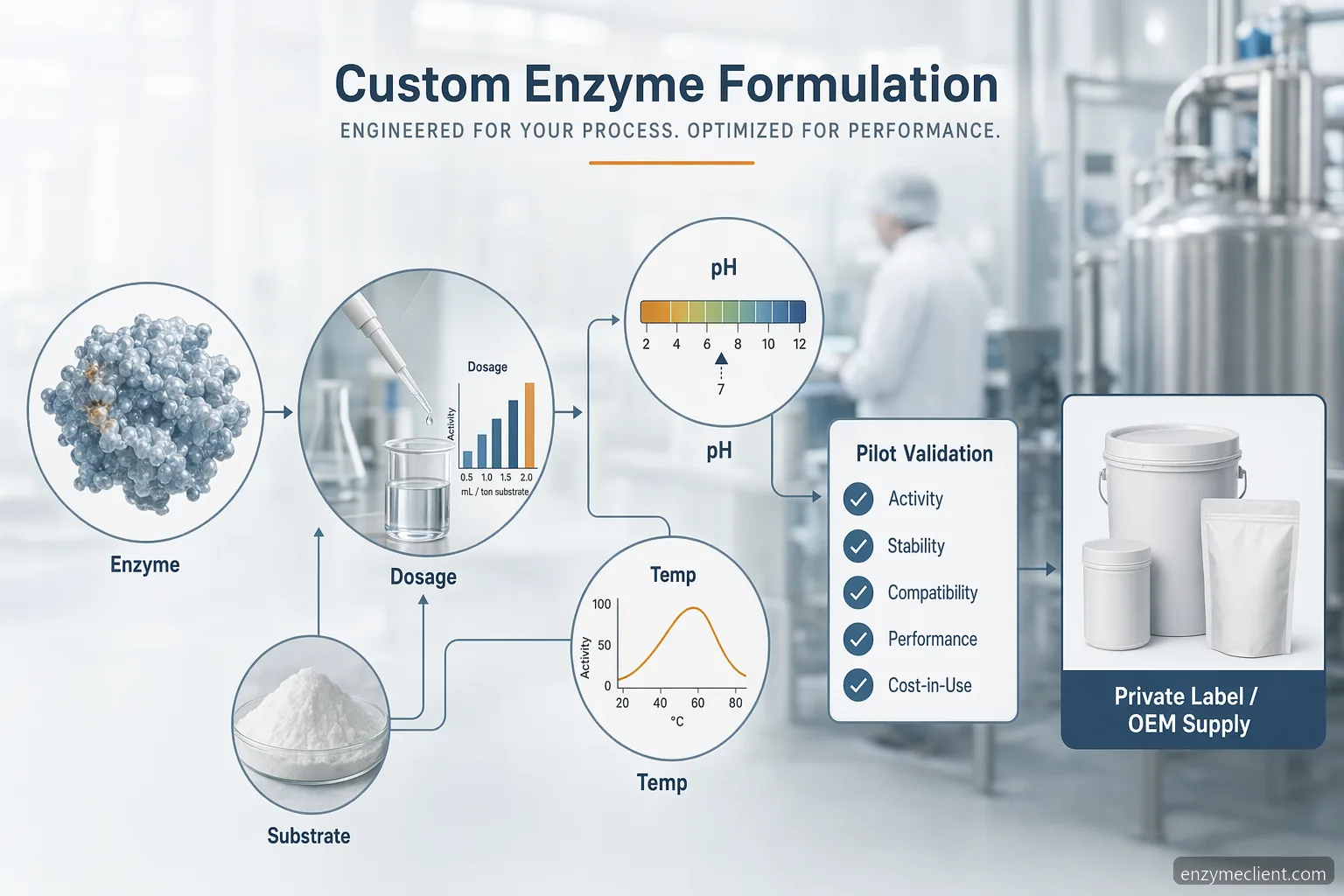
Why Custom Formulation Fails in Industrial Enzyme Projects
Industrial custom enzyme formulation custom formulation projects often fail when the enzyme is chosen before the process is fully mapped. A protease, amylase, cellulase, lipase, pectinase, or blended preparation may perform well in a lab screen but underperform when pH drifts, temperature changes, inhibitors are present, or substrate quality varies by supplier. Troubleshooting should begin with the operating window: pH, temperature, solids level, mixing energy, contact time, and downstream kill or separation steps. Buyers should also define what “success” means: faster hydrolysis, lower viscosity, improved yield, reduced rework, lower chemical use, or better cleaning performance. An enzyme contract manufacturing supplier for custom formulation should be able to translate these targets into a formulation brief, pilot plan, and QC specification rather than simply quoting a catalog product.
Confirm the actual process pH and temperature, not only the design setpoint. • Check whether surfactants, salts, oxidizers, solvents, or preservatives reduce activity. • Measure performance on production substrate, not only analytical-grade material.
Dosage, pH, and Temperature Troubleshooting
A practical starting dosage for many industrial enzyme trials is 0.01% to 0.50% w/w or w/v of the process stream, then narrowed through response testing. High-value or highly active preparations may be dosed lower, while difficult substrates may require staged addition or longer residence time. Common working ranges include pH 4.0 to 6.5 for many fungal carbohydrases, pH 6.0 to 8.5 for many bacterial proteases, and 35°C to 65°C for numerous aqueous processes. Some applications may need lower or higher conditions, so the TDS should define the recommended operating window. If performance drops, run a small matrix: three dosage levels, three pH points, and two temperatures. This quickly shows whether the issue is enzyme loading, denaturation, poor substrate access, or incompatible process chemistry.
Avoid assuming that higher dosage always lowers cost-in-use. • Track reaction time and endpoint, not only initial activity. • Use buffered lab trials before confirming in plant water or actual process liquor.
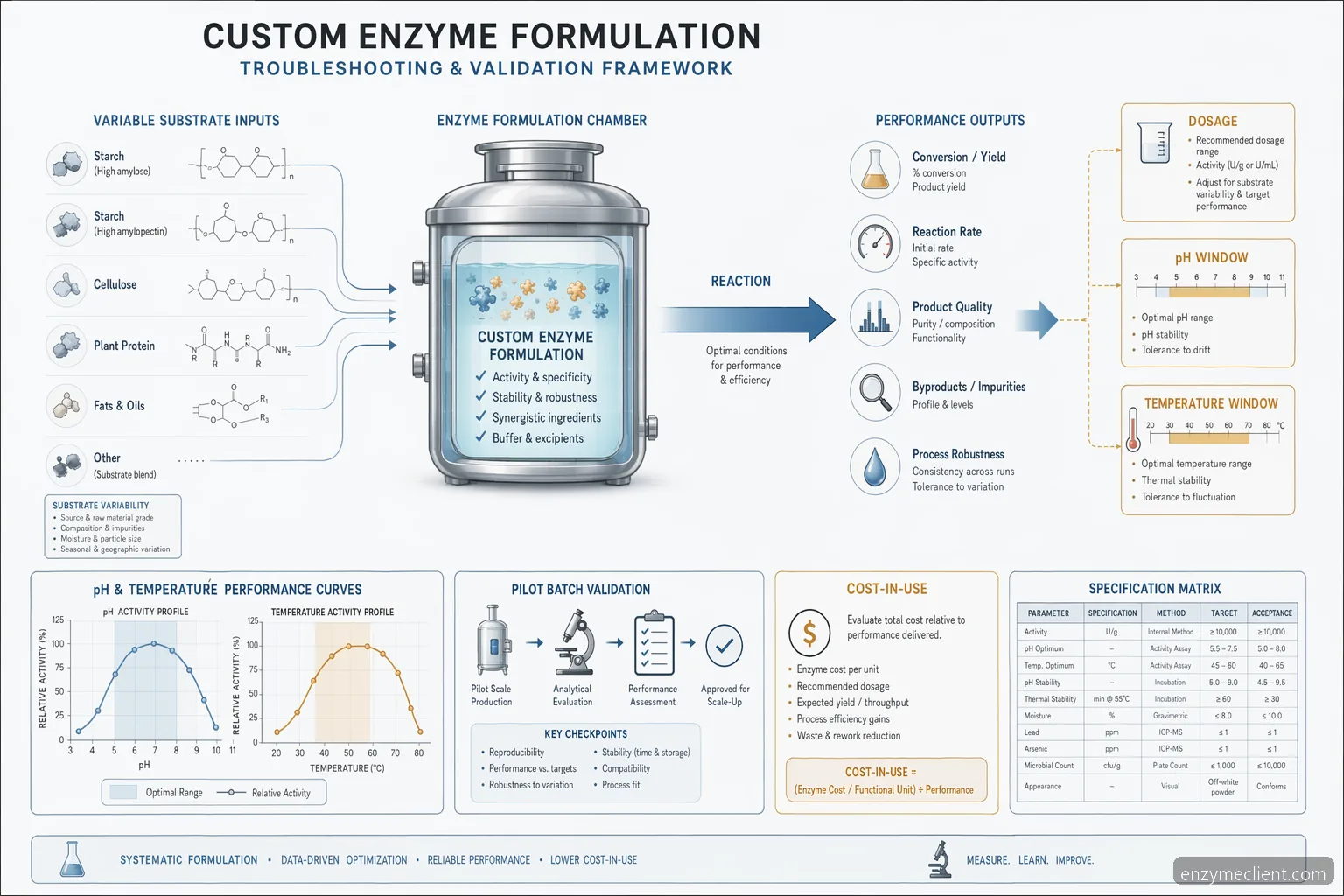
Pilot Validation Before Contract Manufacturing
Industrial enzyme contract manufacturing custom formulation should move through a controlled pilot stage before commercial supply. The pilot should use representative raw materials, plant water, expected hold times, and the same addition point planned for production. For enzyme contract manufacturing for custom formulation, the supplier should provide a written batch record, sample coding, test methods, and acceptance criteria for activity, appearance, pH, density, moisture or solids, microbial limits where relevant, and stability. Pilot validation should also compare the custom blend against the current process baseline and calculate cost-in-use. A slightly higher enzyme price may be justified if it reduces dosage, cycle time, waste, heating, reprocessing, or cleaning chemicals. Documenting these results gives procurement, R&D, operations, and quality a common basis for approval.
Run pilot lots at minimum, target, and maximum proposed dosage. • Retain samples for stability and complaint investigation. • Confirm that packaging supports dosing accuracy and storage conditions.
Private Label and OEM Enzyme Supply Considerations
Industrial custom enzyme formulation private label projects require more than filling a drum, tote, or bottle. The buyer and supplier should agree on formulation ownership, ingredient disclosure level, label claims, storage instructions, shelf-life basis, and change notification. Industrial private label enzymes custom formulation programs also need packaging compatibility, tamper evidence where needed, lot coding, and documentation support. For enzyme OEM supply, the same formulation may be adjusted for viscosity, odor, color, preservation, dust control, or liquid stability depending on the end-use format. A custom enzyme formulation supplier for private label should support COA, TDS, SDS, production samples, and agreed QC tests for every lot. Avoid vague specifications such as “commercial grade” without activity units, method references, and release limits.
Define whether the product is liquid, granulated, powder, slurry, or encapsulated. • Confirm storage conditions such as 5°C to 25°C or ambient warehouse stability. • Agree on notification rules for raw material, process, or specification changes.
Supplier Qualification and Cost-in-Use Review
A custom enzyme formulation supplier for custom formulation should be evaluated on technical fit, documentation, consistency, responsiveness, and scale-up discipline. Qualification should include sample performance, production capability, traceability, COA accuracy, SDS completeness, and the ability to support troubleshooting after launch. Ask for typical lead times, minimum order quantities, batch size options, retention-sample policy, and how deviations are handled. Cost-in-use should include enzyme dosage, yield improvement, process time, waste reduction, energy, storage, freight, labor, and downtime risk. This approach is especially important for custom enzyme formulation for private label, where product failure can affect both the buyer’s customer relationship and brand reputation. A structured qualification process reduces surprises when moving from lab success to repeat commercial production.
Review COA results against agreed release specifications for each lot. • Request TDS and SDS before purchasing or reformulating. • Compare suppliers using pilot data, not only quoted enzyme concentration.
Technical Buying Checklist
Buyer Questions
Start with a dosage ladder rather than a single trial. Many projects begin at 0.01% to 0.50% w/w or w/v, depending on substrate difficulty, activity level, and contact time. Measure the process endpoint, not only enzyme activity. The best dosage is usually the lowest level that consistently meets performance targets in pilot conditions and delivers the strongest cost-in-use.
Request a COA for every lot, plus current TDS and SDS before approval. The COA should match agreed release specifications and test methods. The TDS should show recommended use conditions, storage, handling, and typical properties. For supplier qualification, also ask about batch traceability, retention samples, deviation handling, lead times, and change-control practices.
Sometimes, but it should not be assumed. Different customers may run different pH, temperature, water hardness, substrate quality, surfactants, preservatives, or residence times. A private label formula may need an operating range broad enough for typical users, or separate variants for specific processes. Pilot validation helps determine whether one formulation is robust or whether segmentation is safer.
Common causes include pH drift, heat exposure, poor mixing, short contact time, substrate variability, inhibitors, incompatible preservatives, or dosing at the wrong process point. Lab trials often use controlled buffers and clean substrates, while production includes real water, solids, shear, and hold-time variation. Repeating trials with actual plant materials usually identifies the limiting factor.
Compare suppliers using pilot data, documentation quality, batch consistency, responsiveness, and cost-in-use. A low quoted price may not be economical if dosage is higher, stability is weaker, or production support is limited. Review COA accuracy, TDS clarity, SDS completeness, lead times, minimum order quantities, retention-sample policy, and willingness to support troubleshooting after commercialization.
Related Search Themes
industrial enzyme contract manufacturing custom formulation, industrial custom enzyme formulation private label, industrial private label enzymes custom formulation, enzyme contract manufacturing supplier for custom formulation, enzyme contract manufacturing for custom formulation, custom enzyme formulation supplier for private label
Lipase (Thermostable) for Research & Industry
Need Lipase (Thermostable) for your lab or production process?
ISO 9001 certified · Food-grade & research-grade · Ships to 80+ countries
Frequently Asked Questions
How do we choose the right dosage for an industrial custom enzyme formulation?
Start with a dosage ladder rather than a single trial. Many projects begin at 0.01% to 0.50% w/w or w/v, depending on substrate difficulty, activity level, and contact time. Measure the process endpoint, not only enzyme activity. The best dosage is usually the lowest level that consistently meets performance targets in pilot conditions and delivers the strongest cost-in-use.
What documents should we request from an enzyme contract manufacturing supplier?
Request a COA for every lot, plus current TDS and SDS before approval. The COA should match agreed release specifications and test methods. The TDS should show recommended use conditions, storage, handling, and typical properties. For supplier qualification, also ask about batch traceability, retention samples, deviation handling, lead times, and change-control practices.
Can one private label enzyme formula work across different customer processes?
Sometimes, but it should not be assumed. Different customers may run different pH, temperature, water hardness, substrate quality, surfactants, preservatives, or residence times. A private label formula may need an operating range broad enough for typical users, or separate variants for specific processes. Pilot validation helps determine whether one formulation is robust or whether segmentation is safer.
Why does an enzyme work in the lab but fail during production?
Common causes include pH drift, heat exposure, poor mixing, short contact time, substrate variability, inhibitors, incompatible preservatives, or dosing at the wrong process point. Lab trials often use controlled buffers and clean substrates, while production includes real water, solids, shear, and hold-time variation. Repeating trials with actual plant materials usually identifies the limiting factor.
How should we compare custom enzyme formulation suppliers?
Compare suppliers using pilot data, documentation quality, batch consistency, responsiveness, and cost-in-use. A low quoted price may not be economical if dosage is higher, stability is weaker, or production support is limited. Review COA accuracy, TDS clarity, SDS completeness, lead times, minimum order quantities, retention-sample policy, and willingness to support troubleshooting after commercialization.
Related: Custom Enzyme Formulation for Demanding Process Lines
Turn This Guide Into a Supplier Brief Send your process conditions to enzymeclient.com to discuss a custom enzyme formulation, pilot plan, and private label supply path. See our application page for Custom Enzyme Formulation for Demanding Process Lines at /applications/custom-enzyme-formulation-faqs/ for specs, MOQ, and a free 50 g sample.
Contact Us to Contribute