Industrial Enzyme Contract Manufacturing Custom Formulation Checklist
Compare enzyme contract manufacturing suppliers for custom formulation, private label, pilot validation, QC, COA/TDS/SDS, and cost-in-use.
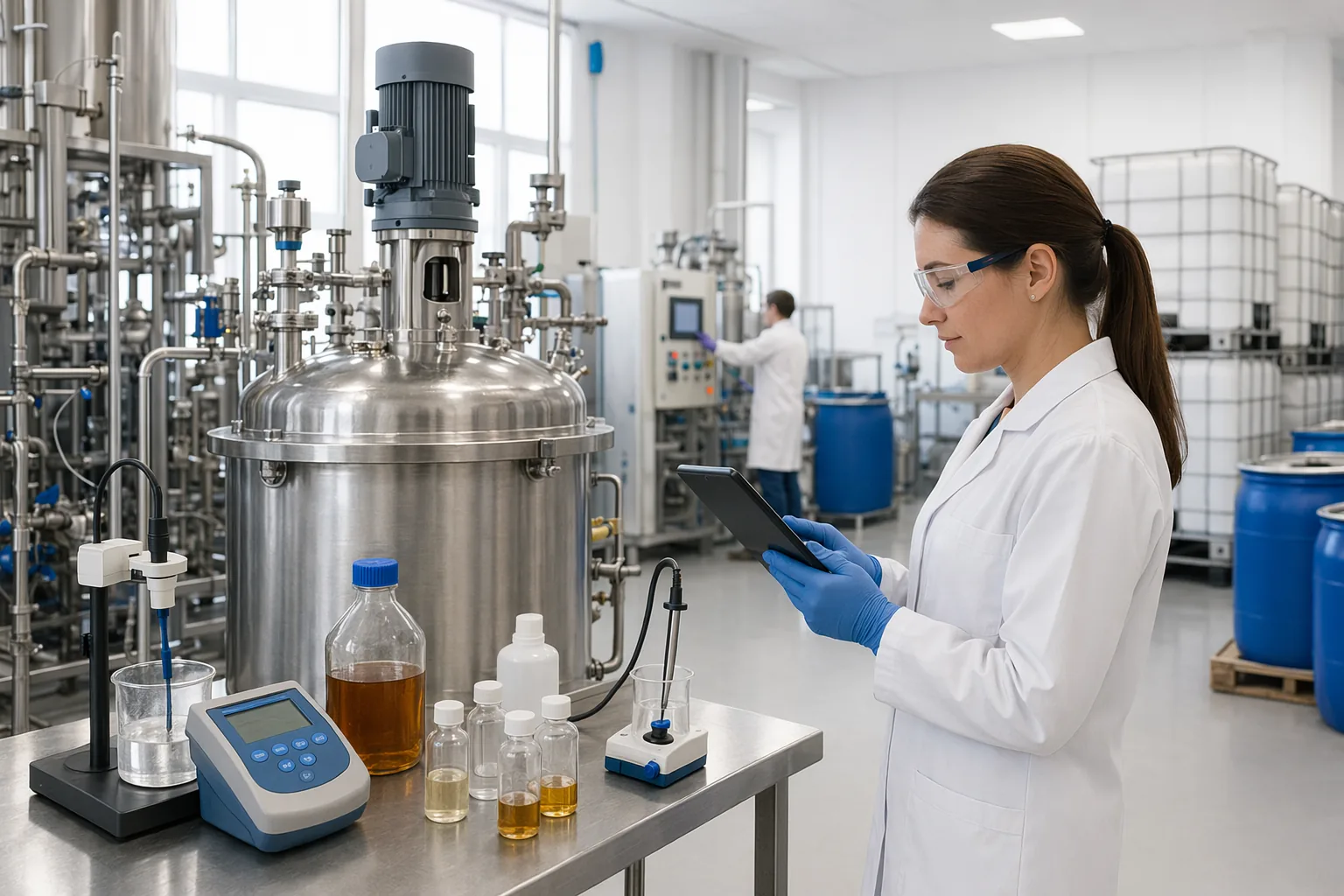
Use this B2B specification checklist to compare industrial enzyme contract manufacturing custom formulation partners for process fit, private label readiness, pilot validation, documentation, and cost-in-use.
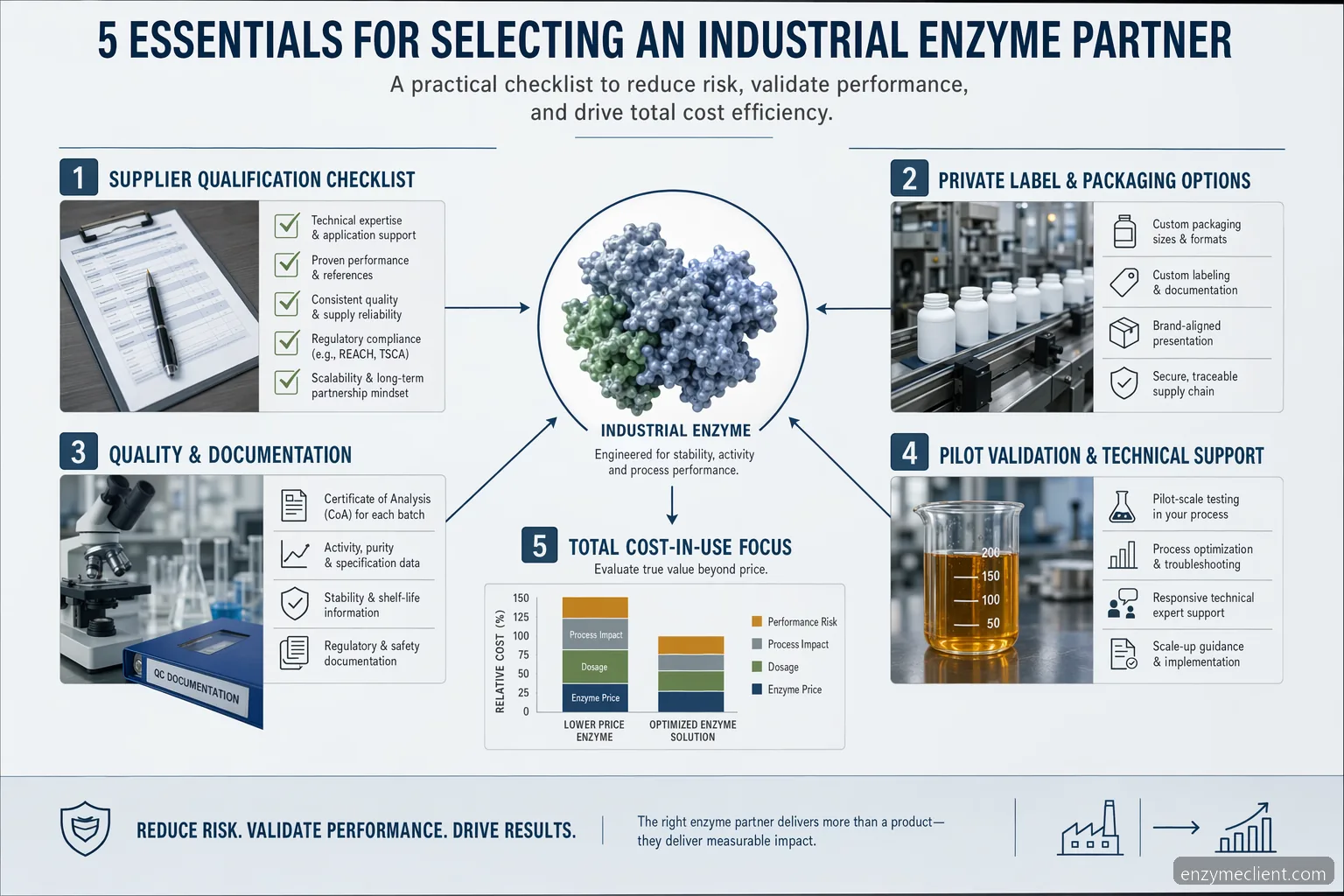
What Buyers Should Compare Before Selecting a Supplier
Industrial enzyme contract manufacturing custom formulation projects succeed when the buyer compares more than toll blending capacity. A qualified partner should translate application goals into measurable specifications: enzyme class, activity target, carrier system, dilution, preservation strategy, pH tolerance, temperature range, and packaging format. For custom formulation, the supplier should also discuss the operating window, such as pH 4.5–7.5 for many carbohydrate processes or 30–65°C for common industrial processing environments, while confirming the actual enzyme system by pilot testing. Ask whether the supplier can support liquid concentrates, granules, powders, blends, or private label enzymes under your brand. The best comparison also includes responsiveness, technical documentation, sample turnaround, change-control discipline, and ability to troubleshoot variability in raw materials or process water. This is a procurement and process-performance decision, not a consumer supplement recommendation.
Compare technical fit, not just quoted unit price. • Confirm enzyme type, activity method, and release specification. • Ask for application support during pilot trials. • Match packaging to storage, dosing, and safety requirements.
Application Data Needed for Custom Formulation
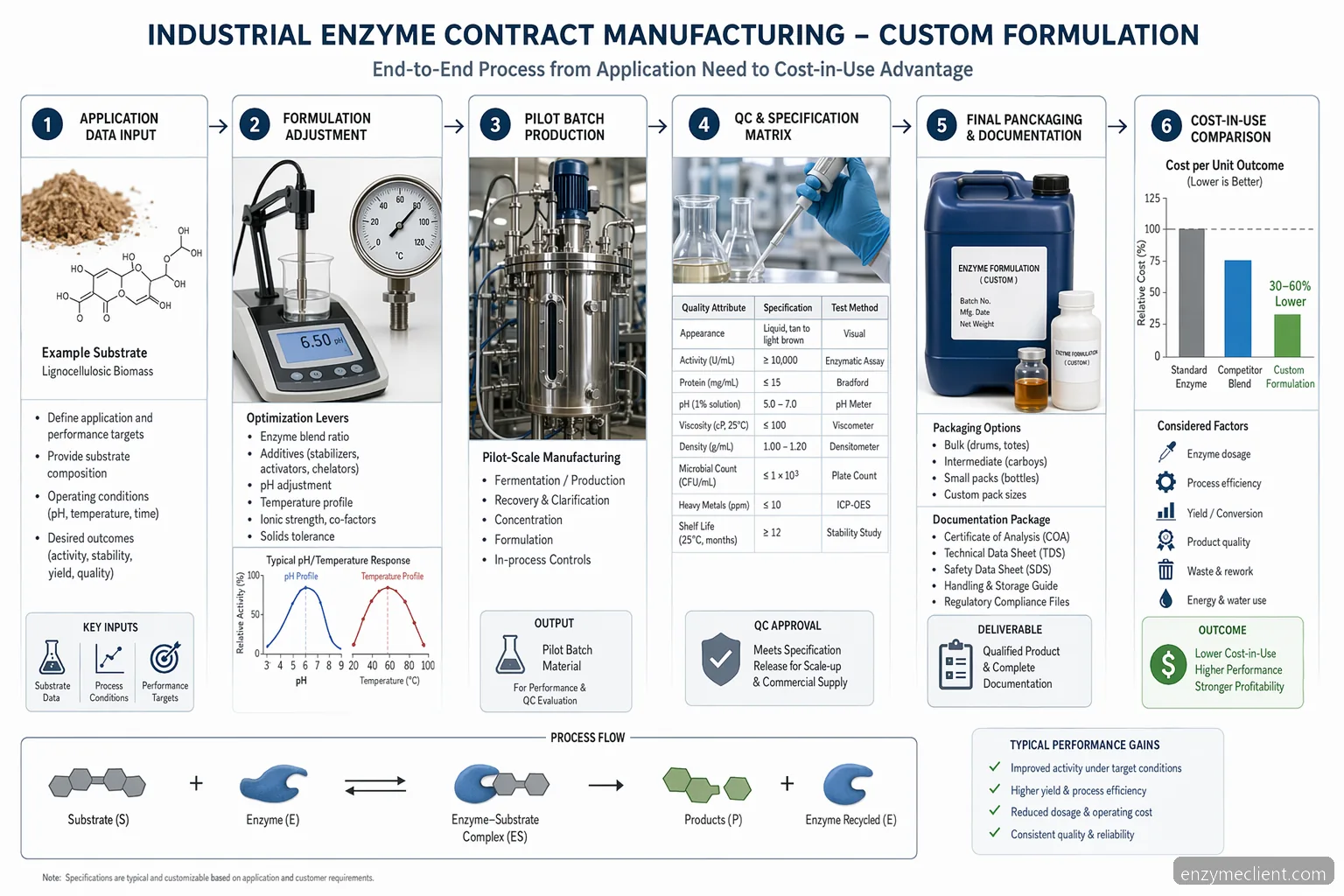
An enzyme contract manufacturing supplier for custom formulation will need practical process data before proposing a stable and cost-effective product. Provide substrate composition, solids level, expected contaminants, process water hardness, surfactants or solvents present, target cycle time, and downstream separation steps. Include the normal and maximum operating pH and temperature, because enzymes may lose activity outside their designed range. For example, a formulation used in a wash or pretreatment step may need stability across pH 7–10 and 25–55°C, while a food or fermentation auxiliary may require narrower controls. Share current dosage bands, such as 0.05–0.5% by weight or 50–500 ppm active preparation, only as starting points for screening. Pilot validation should establish the final dose, because substrate variability and dwell time often determine true performance.
Substrate type and variability • pH, temperature, time, and mixing conditions • Current dosage and performance target • Known inhibitors, sanitizers, oxidizers, or surfactants • Downstream filtration, drying, or wastewater limits
Private Label, OEM, and Packaging Considerations
Industrial enzyme contract manufacturing private label projects require more than a label template. A supplier should define who owns the formulation, how revisions are approved, and which party controls label claims, safety statements, and market-specific documentation. For industrial custom enzyme formulation private label programs, packaging must protect enzyme activity and fit the buyer’s handling system. Common options include drums, totes, pails, bags, water-soluble sachets, and intermediate bulk containers, depending on liquid or dry format. Buyers should confirm fill tolerances, closure compatibility, moisture control, dust management, and pallet configuration. For enzyme OEM supply, clarify lead times, minimum order quantities, retained samples, shelf-life monitoring, and confidentiality expectations. A strong supplier can support private label enzymes while maintaining lot traceability and consistent QC release criteria.
Confirm formulation ownership and change-control rules. • Specify pack size, closure, palletization, and label responsibilities. • Review shelf life under expected storage conditions. • Align MOQ and lead time with demand forecasts.
QC, Documentation, and Supplier Qualification
When comparing enzyme contract manufacturing for private label or custom formulation, documentation quality is a core supplier qualification factor. Each commercial lot should have a COA showing agreed tests such as enzyme activity, appearance, pH, density or moisture, microbial limits where relevant, and fill quantity. A TDS should describe intended industrial use, typical dosage range, handling guidance, storage conditions, and compatibility notes. An SDS should address hazards, personal protective equipment, spill response, and transport information. Buyers should request representative stability data, retained-sample procedures, allergen or animal-origin statements where relevant to the market, and a clear deviation process. Supplier audits can focus on raw material control, batch records, sanitation, calibration, segregation, packaging verification, and traceability from incoming enzyme concentrate to shipped finished goods.
COA for each production lot • TDS for application and storage guidance • SDS for safe industrial handling • Batch records, retained samples, and traceability • Defined deviation and change notification process
Pilot Validation and Cost-in-Use Comparison
Industrial custom enzyme formulation custom formulation work should move from lab screening to pilot validation before scale-up. A practical pilot compares the proposed enzyme against the current process or competing options using the same substrate, equipment conditions, and performance metrics. Track activity retention, conversion yield, cleaning efficiency, viscosity reduction, fiber modification, stain removal, or other application-specific outcomes. Dosage should be tested across a realistic band, such as 0.02–1.0% formulation or a defined activity-unit range, with pH and temperature logged throughout the run. Cost-in-use should include delivered price, required dose, yield change, cycle-time reduction, waste reduction, storage losses, and handling requirements. This approach helps buyers identify the best enzyme contract manufacturing supplier for private label or custom formulation without relying on price per kilogram alone.
Run side-by-side trials under actual process conditions. • Measure performance and enzyme dose together. • Include logistics, shelf life, and handling in total cost. • Use pilot data to finalize release specifications.
Technical Buying Checklist
Buyer Questions
Standard resale typically offers an existing enzyme product with limited changes to concentration, packaging, or documentation. Enzyme contract manufacturing for custom formulation adapts the enzyme system to your substrate, pH, temperature, dosage, stability, handling, and private label requirements. It may include lab screening, pilot validation, custom QC specifications, packaging selection, and commercial batch records aligned with your procurement and process needs.
Provide the application goal, substrate composition, operating pH, temperature, dwell time, mixing conditions, water quality, current dosage, competing chemistry, and performance target. Also share packaging requirements, expected monthly volume, storage conditions, and documentation needs such as COA, TDS, SDS, and lot traceability. The more complete the process data, the faster a supplier can propose a realistic formulation and pilot plan.
Yes, industrial private label enzymes custom formulation programs can be built around your process and brand requirements. Customization may include enzyme blend, activity level, stabilizers, color, fragrance where appropriate, carrier, viscosity, packaging, and label documentation. The supplier should still validate performance under your process conditions and define change-control rules so the private label product remains consistent over time.
The COA should reflect agreed release criteria, usually including enzyme activity by a defined method, appearance, pH, density or viscosity for liquids, moisture for powders, and packaging quantity. Depending on application risk, microbial limits, particle size, or solubility may also be included. The key is to connect QC tests to performance, storage stability, and safe industrial handling rather than using generic checks only.
Compare total cost-in-use by measuring the dose needed to reach the same process result, not only the price per kilogram. Include yield improvement, cycle-time reduction, energy savings, waste reduction, labor impact, storage losses, freight, and packaging efficiency. A higher-concentration or better-stabilized formulation may reduce total cost if it performs at lower dosage or improves process consistency during pilot validation.
Related Search Themes
enzyme contract manufacturing supplier for custom formulation, enzyme contract manufacturing for custom formulation, industrial enzyme contract manufacturing private label, industrial custom enzyme formulation private label, industrial custom enzyme formulation custom formulation, industrial private label enzymes custom formulation
Lipase (Thermostable) for Research & Industry
Need Lipase (Thermostable) for your lab or production process?
ISO 9001 certified · Food-grade & research-grade · Ships to 80+ countries
Frequently Asked Questions
How is enzyme contract manufacturing for custom formulation different from standard enzyme resale?
Standard resale typically offers an existing enzyme product with limited changes to concentration, packaging, or documentation. Enzyme contract manufacturing for custom formulation adapts the enzyme system to your substrate, pH, temperature, dosage, stability, handling, and private label requirements. It may include lab screening, pilot validation, custom QC specifications, packaging selection, and commercial batch records aligned with your procurement and process needs.
What information should we provide to an industrial enzyme contract manufacturing supplier?
Provide the application goal, substrate composition, operating pH, temperature, dwell time, mixing conditions, water quality, current dosage, competing chemistry, and performance target. Also share packaging requirements, expected monthly volume, storage conditions, and documentation needs such as COA, TDS, SDS, and lot traceability. The more complete the process data, the faster a supplier can propose a realistic formulation and pilot plan.
Can private label enzymes be customized for our process?
Yes, industrial private label enzymes custom formulation programs can be built around your process and brand requirements. Customization may include enzyme blend, activity level, stabilizers, color, fragrance where appropriate, carrier, viscosity, packaging, and label documentation. The supplier should still validate performance under your process conditions and define change-control rules so the private label product remains consistent over time.
What QC checks should be included on the COA?
The COA should reflect agreed release criteria, usually including enzyme activity by a defined method, appearance, pH, density or viscosity for liquids, moisture for powders, and packaging quantity. Depending on application risk, microbial limits, particle size, or solubility may also be included. The key is to connect QC tests to performance, storage stability, and safe industrial handling rather than using generic checks only.
How should we compare cost-in-use between enzyme suppliers?
Compare total cost-in-use by measuring the dose needed to reach the same process result, not only the price per kilogram. Include yield improvement, cycle-time reduction, energy savings, waste reduction, labor impact, storage losses, freight, and packaging efficiency. A higher-concentration or better-stabilized formulation may reduce total cost if it performs at lower dosage or improves process consistency during pilot validation.
Related: Custom Enzyme Formulation for Demanding Process Lines
Turn This Guide Into a Supplier Brief Request a custom enzyme formulation review, pilot plan, and contract manufacturing quote for your industrial application. See our application page for Custom Enzyme Formulation for Demanding Process Lines at /applications/custom-enzyme-formulation-faqs/ for specs, MOQ, and a free 50 g sample.
Contact Us to Contribute