Private Label Enzymes for Custom Formulation
Source private label enzymes for custom formulation with pilot validation, COA/TDS/SDS review, QC checks, dosage guidance, and cost-in-use support.
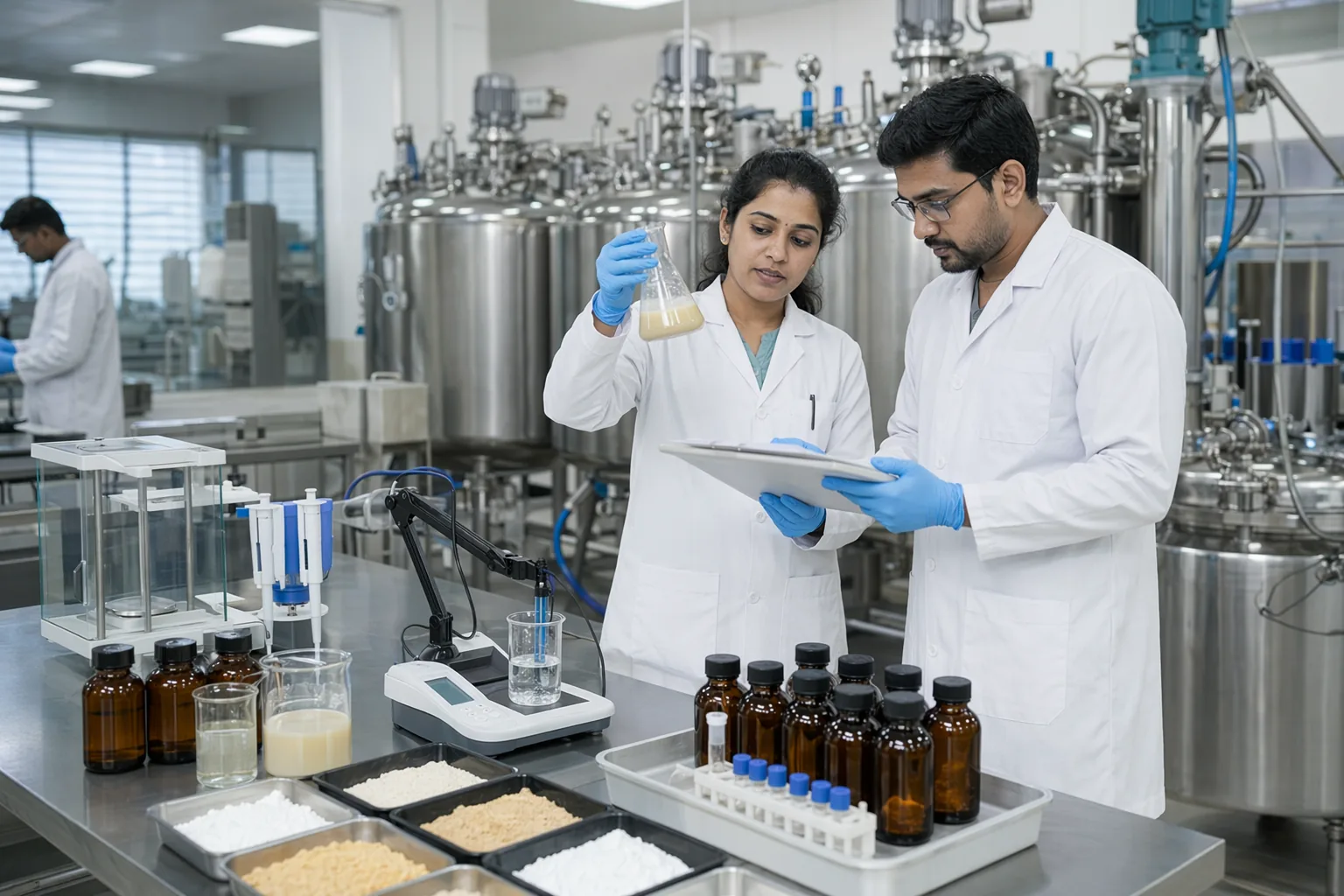
Build market-ready industrial enzyme products with tailored activity targets, documented quality, and scalable private label manufacturing support.
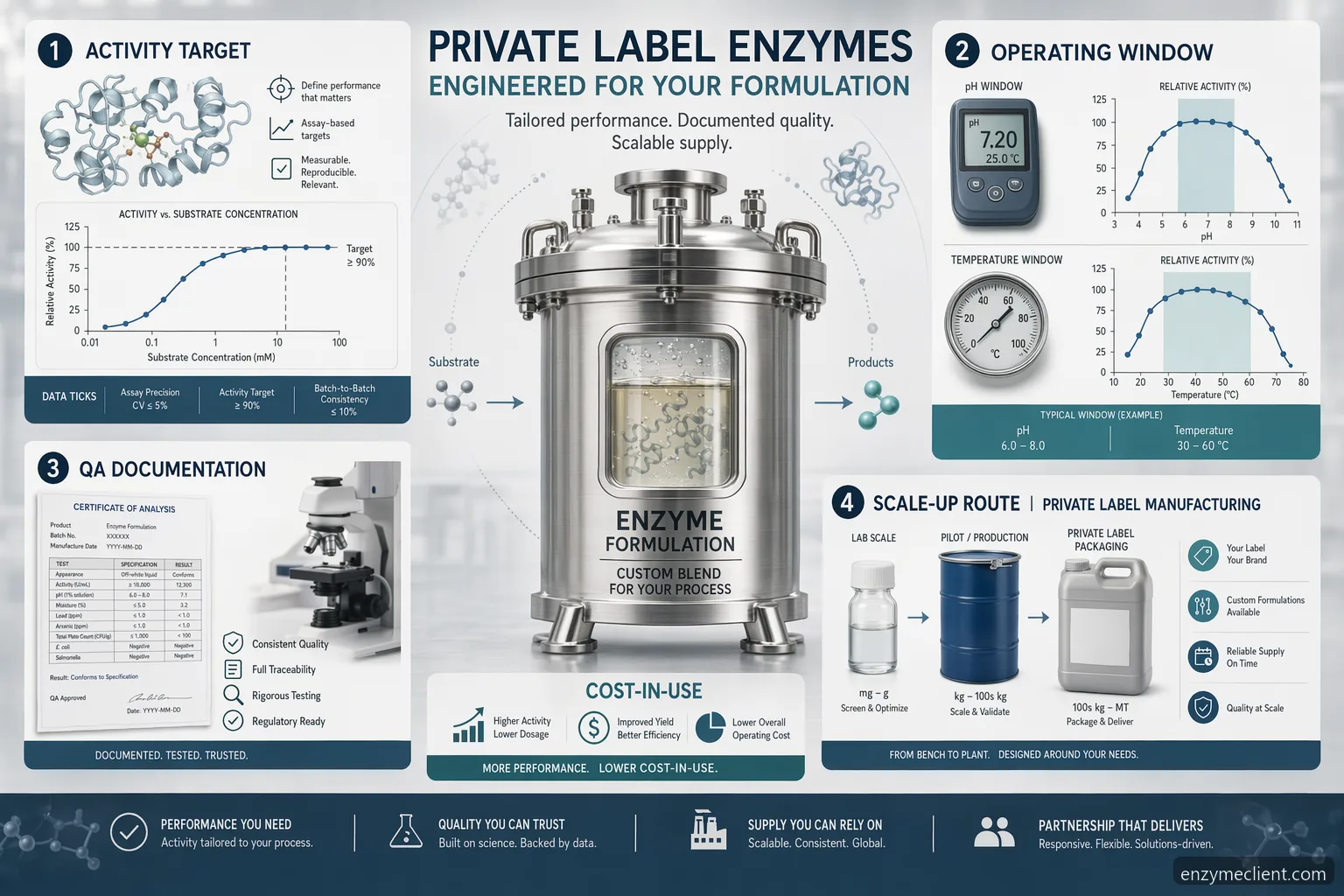
Start with the formulation objective
Successful private label enzymes for custom formulation begin with a clear technical brief, not a catalog selection. Define the substrate, process step, desired performance outcome, finished product format, regulatory market, and target cost-in-use. A laundry pre-spotter, pulp-processing aid, animal feed premix, wastewater additive, and starch-processing blend may all use enzymes, but each requires different activity profiles, carriers, stabilizers, and handling instructions. For B2B buyers, the right custom enzyme formulation supplier for private label work should translate commercial goals into measurable enzyme specifications. That includes activity units, assay method, minimum shelf-life target, moisture limit, microbial limits where relevant, and compatibility with surfactants, salts, solvents, preservatives, or other actives. This approach helps avoid over-formulation, instability, and unnecessary raw material cost while keeping the finished private label product aligned with its intended industrial use.
Define substrate and operating environment before selecting enzyme class. • Set target activity and acceptable activity loss during storage. • Identify incompatible ingredients early, especially oxidizers and extreme pH systems. • Separate marketing claims from measurable technical performance.
Control pH, temperature, and dosage windows
Industrial custom enzyme formulation private label projects should be built around realistic process conditions. Many proteases operate effectively near neutral to alkaline pH, often around pH 7.0–10.5, while many amylases and cellulases are commonly used in mildly acidic to neutral ranges, depending on source and application. Temperature windows often fall between 25–65°C for liquid cleaning, textile, feed, and processing applications, although specific enzyme grades may require narrower limits. Dosage should be evaluated as a band, not a fixed number; initial screening may use 0.05–1.0% in finished liquid formulations or 50–1,000 ppm in process applications, then refine based on activity and cost-in-use. Safe guidance must come from product-specific TDS, SDS, and pilot data. The goal is to identify a reliable operating range that survives manufacturing, storage, and customer use.
Screen pH stability across the finished formulation’s expected range. • Test activity after heat exposure, mixing, and hold time. • Confirm dosage by performance per unit cost, not enzyme percentage alone. • Use product-specific TDS and SDS before setting commercial instructions.
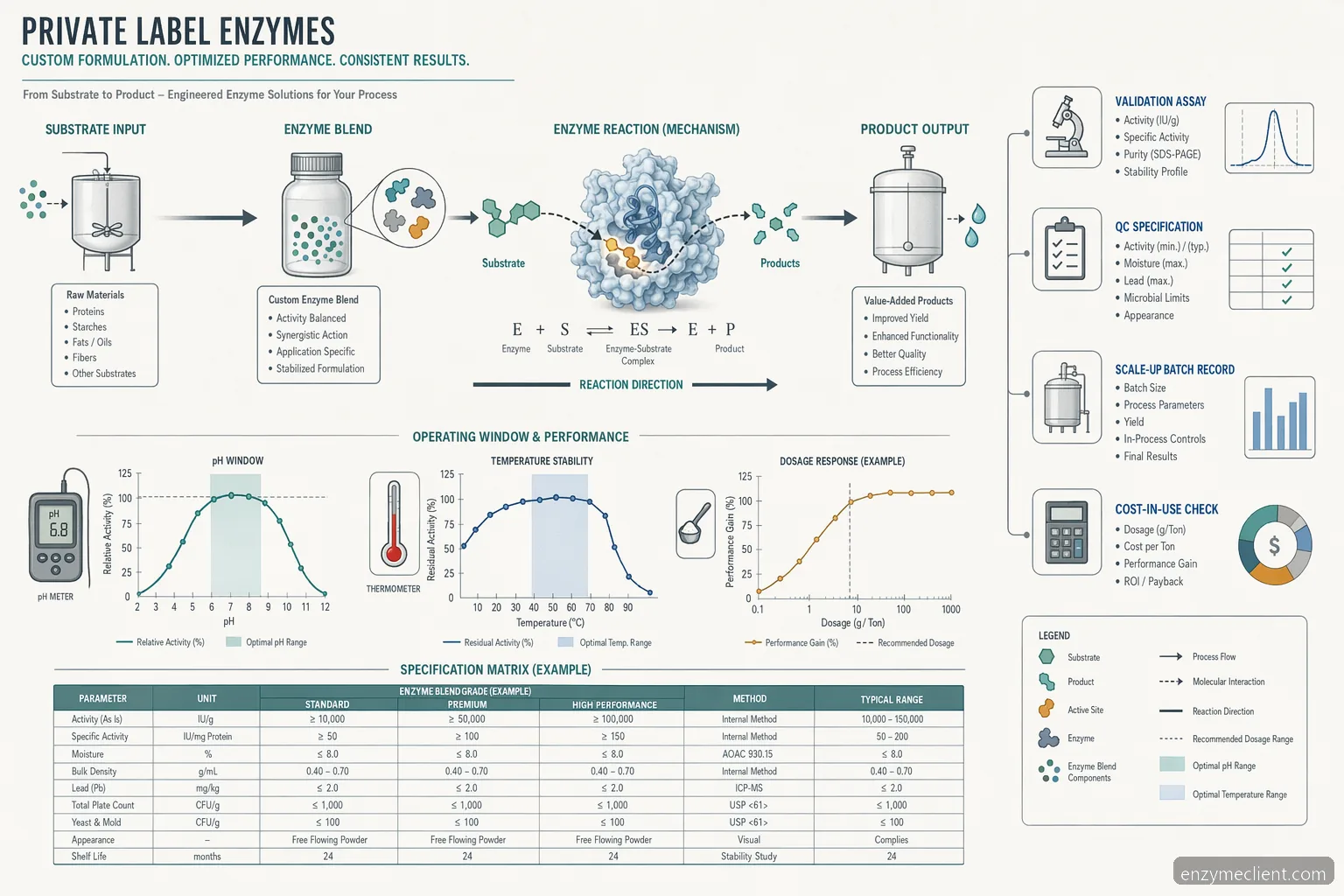
Design the private label manufacturing route
A private label enzymes supplier for custom formulation should support more than filling containers. The manufacturing route must account for enzyme sensitivity during dilution, blending, granulation, spray application, or powder premixing. Liquid enzymes may require controlled mixing speed, low-foam handling, preservatives, buffers, chelants, or humectants to maintain activity. Dry products may require carrier selection, particle-size control, dust-management practices, and moisture protection. For enzyme OEM projects, the supplier should define batch size, order of addition, in-process checks, packaging configuration, label control, retained samples, and change-control procedures. Industrial private label enzymes custom formulation programs also benefit from clear decisions on concentration strategy: a high-activity concentrate can reduce freight and warehousing cost, while a ready-to-use finished product may simplify customer dosing. The best route is the one that protects performance while fitting the buyer’s logistics and market plan.
Choose liquid, powder, granule, or concentrate format based on use case. • Validate carrier compatibility and moisture sensitivity for dry blends. • Use defined order of addition to reduce activity loss. • Align packaging with dosing method, shelf life, and transport conditions.
Validate performance before scale-up
Custom enzyme formulation for private label launch should move through bench screening, pilot validation, and controlled scale-up. Bench tests confirm candidate enzyme classes and approximate dosage. Pilot trials then measure performance under realistic pH, temperature, residence time, water quality, substrate loading, and mixing conditions. QC checks should include enzyme activity assay, appearance, pH, viscosity or bulk density, moisture for powders, microbial indicators where relevant, and packaging integrity. Stability testing should compare initial activity with retained activity after accelerated and real-time storage, using the same container planned for sale. COA/TDS/SDS review is essential before approving artwork, instructions, or customer-facing claims. A disciplined pilot program reduces the risk that a formulation performs in the lab but fails in plant, field, or customer production conditions.
Run bench tests to narrow enzyme type and dosage range. • Use pilot batches to confirm process robustness and packaging fit. • Compare initial and aged activity using a defined assay method. • Review COA, TDS, and SDS before commercial release.
Evaluate supplier qualification and cost-in-use
Choosing a private label enzymes supplier for private label growth requires technical, commercial, and documentation due diligence. Buyers should request representative samples, current TDS, SDS, sample COA, typical lead times, minimum order quantities, packaging options, and batch traceability practices. Cost-in-use should be calculated from delivered cost, enzyme activity, required dosage, yield improvement, processing time saved, waste reduction, or cleaning performance achieved. The lowest price per kilogram may not be the lowest operating cost if activity is weak or stability is poor. Industrial private label enzymes private label projects also need contingency planning for raw material availability, formulation change notification, and repeat-batch consistency. Supplier qualification should include sample testing, pilot approval, commercial batch review, retained sample comparison, and periodic performance audits based on agreed specifications.
Compare suppliers by activity-adjusted cost, not price per drum alone. • Request sample COA and lot traceability before approval. • Confirm lead time, MOQ, packaging, and change-notification expectations. • Use retained samples to investigate future performance questions.
Technical Buying Checklist
Buyer Questions
Standard enzyme ingredients are usually sold as raw materials for a buyer to formulate independently. Private label enzymes for custom formulation are developed, blended, packaged, and documented around the buyer’s finished product requirements. This may include custom activity targets, carriers, stabilizers, packaging sizes, label-ready documentation, batch records, COA/TDS/SDS support, and pilot validation before commercial supply.
Start with the substrate and process conditions. Identify whether the application requires protease, amylase, cellulase, lipase, xylanase, pectinase, or a multi-enzyme blend. Then screen candidates across the expected pH, temperature, residence time, and ingredient matrix. The final choice should be based on measured performance, stability, handling safety, documentation quality, and cost-in-use rather than enzyme name alone.
At minimum, request a technical data sheet, safety data sheet, and certificate of analysis for representative and commercial lots. For private label work, also ask for storage guidance, shelf-life basis, assay method, packaging specifications, lot traceability, sample retention practices, and any formulation-specific handling notes. Documentation should be reviewed before approving labels, customer instructions, or procurement specifications.
Dosage depends on enzyme activity, substrate concentration, contact time, pH, temperature, inhibitors, and the performance target. Early screening may evaluate broad bands such as 0.05–1.0% in finished liquid products or ppm-level dosing in process applications. Pilot validation should then refine the dose to the lowest level that meets performance, stability, and customer-use requirements at an acceptable cost-in-use.
Pilot validation confirms that the enzyme performs outside the lab and survives the planned manufacturing route. It checks mixing order, shear exposure, hold time, pH drift, temperature exposure, packaging compatibility, and activity retention. For enzyme contract manufacturing, pilot data helps lock the formula, batch record, QC limits, packaging plan, and cost model before committing to commercial production volumes.
Related Search Themes
private label enzymes supplier for custom formulation, industrial private label enzymes custom formulation, industrial custom enzyme formulation private label, custom enzyme formulation supplier for private label, custom enzyme formulation for private label, private label enzymes supplier for private label
Lipase (Thermostable) for Research & Industry
Need Lipase (Thermostable) for your lab or production process?
ISO 9001 certified · Food-grade & research-grade · Ships to 80+ countries
Frequently Asked Questions
What makes private label enzymes different from standard enzyme ingredients?
Standard enzyme ingredients are usually sold as raw materials for a buyer to formulate independently. Private label enzymes for custom formulation are developed, blended, packaged, and documented around the buyer’s finished product requirements. This may include custom activity targets, carriers, stabilizers, packaging sizes, label-ready documentation, batch records, COA/TDS/SDS support, and pilot validation before commercial supply.
How do I choose the right enzyme for a custom industrial formulation?
Start with the substrate and process conditions. Identify whether the application requires protease, amylase, cellulase, lipase, xylanase, pectinase, or a multi-enzyme blend. Then screen candidates across the expected pH, temperature, residence time, and ingredient matrix. The final choice should be based on measured performance, stability, handling safety, documentation quality, and cost-in-use rather than enzyme name alone.
What documentation should a B2B buyer request from an enzyme supplier?
At minimum, request a technical data sheet, safety data sheet, and certificate of analysis for representative and commercial lots. For private label work, also ask for storage guidance, shelf-life basis, assay method, packaging specifications, lot traceability, sample retention practices, and any formulation-specific handling notes. Documentation should be reviewed before approving labels, customer instructions, or procurement specifications.
What dosage should be used in a new enzyme formulation?
Dosage depends on enzyme activity, substrate concentration, contact time, pH, temperature, inhibitors, and the performance target. Early screening may evaluate broad bands such as 0.05–1.0% in finished liquid products or ppm-level dosing in process applications. Pilot validation should then refine the dose to the lowest level that meets performance, stability, and customer-use requirements at an acceptable cost-in-use.
Why is pilot validation important for enzyme contract manufacturing?
Pilot validation confirms that the enzyme performs outside the lab and survives the planned manufacturing route. It checks mixing order, shear exposure, hold time, pH drift, temperature exposure, packaging compatibility, and activity retention. For enzyme contract manufacturing, pilot data helps lock the formula, batch record, QC limits, packaging plan, and cost model before committing to commercial production volumes.
Related: Custom Enzyme Formulation for Demanding Process Lines
Turn This Guide Into a Supplier Brief Request a custom enzyme formulation review, pilot sample plan, and private label quote from enzymeclient.com. See our application page for Custom Enzyme Formulation for Demanding Process Lines at /applications/custom-enzyme-formulation-faqs/ for specs, MOQ, and a free 50 g sample.
Contact Us to Contribute